

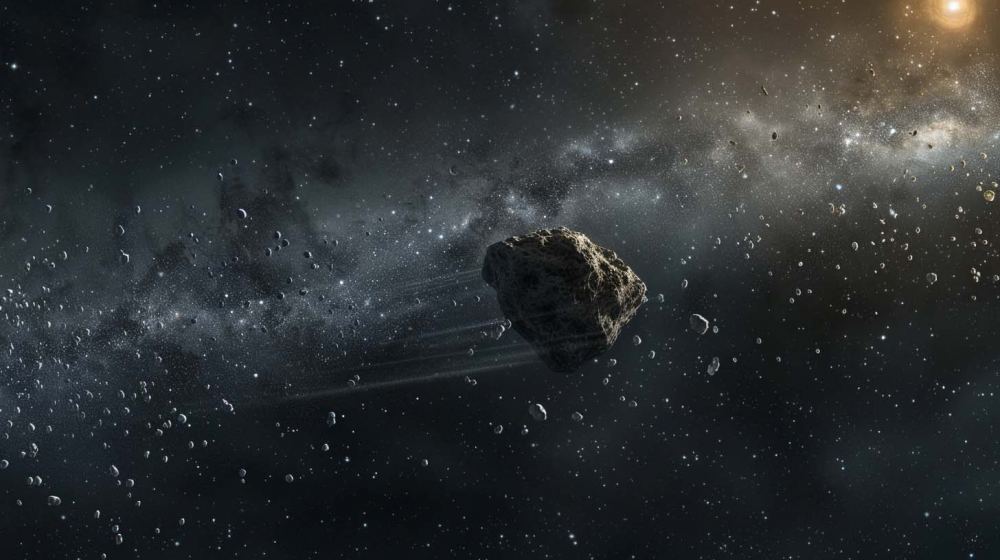
On October 19, 2017, the Panoramic Survey Telescope and Rapid Response System-1 (Pan-STARRS-1) in Hawaii announced the first discovery of an interstellar object named 1I/2017 U1 'Oumuamua (the Hawaiian word for “scout”) “). This object caused a lot of confusion because it looked like an asteroid but behaved like a comet (based on the way it accelerated out of the solar system). Since then, scientists have noticed many other objects that behave in the same way, called “dark comets.”
These objects are defined as “small bodies with no proven coma that exhibit significant nongravitational accelerations that can be explained by volatile outgassing,” similar to “Oumuamua.” In a recent NASA-supported study, a team of researchers identified seven more of these objects in the solar system, doubling the number of known dark comets. More importantly, the researchers were able to distinguish two different populations. They consist of larger objects located in the outer solar system and smaller objects in the inner solar system.
The study was led by Darryl Z. Seligman, an NSF postdoctoral fellow in astronomy and astrophysics at the Carl Sagan Institute at Cornell University and Michigan State University. He was joined by researchers from the European Space Agency's Near-Earth Object Coordination Center (NEOCC), the European Southern Observatory (ESO), the Planetary Science Institute (PSI) and the Laboratory for Atmospheric and Space Physics (LASP) at the University of Colorado Boulder , NASA's Jet Propulsion Laboratory. Their findings were published Dec. 9 in the Proceedings of the National Academy of Sciences (PNAS).
Astronomers are discovering more and more objects that look like asteroids but behave like comets. Photo credits: N. Bartmann (ESA/Webb), ESO/M. Kornmesser and S. Brunier, N. Risinger (skysurvey.org)
Scientists got the clue to the existence of dark comets in 2016 when they noticed that the “asteroid” 2003 RM had deviated slightly from its expected orbit. This behavior could not be explained by the Yarkovsky effect, in which asteroids absorb solar energy and radiate it back into space as heat. Study co-author Davide Farnocchia of NASA JPL said in a NASA press release:
“When you see this type of disturbance on a celestial object, it usually means it is a comet, with volatile material outgassing from its surface, giving it a small boost. But try as we might, we couldn't find any sign of a comet's tail. It looked like any other asteroid – just a tiny dot of light. So for a short period of time we had this one strange celestial object that we couldn’t fully understand.”
The next piece of the puzzle came in 2017 with the discovery of the first interstellar object (“Oumuamua”). While it appeared to telescopes as a single point of light and had no coma, its trajectory changed as if it was outgassing volatile material from its surface. “‘Oumuamua was surprising in several ways,” Farnocchia said. “The fact that the first object we discovered in interstellar space exhibited similar behavior to 2003 RM made 2003 RM even more intriguing.”
As of 2023, seven dark comets have been identified, prompting the astronomical community to call them a distinct category of celestial objects. With this latest study, the authors identified seven more of these objects in the solar system and noted some interesting features among them. “We had such a large number of dark comets that we could start asking if there was anything that could distinguish them,” Seligman said. “By analyzing reflectivity” or albedo “and orbits, we found that our solar system contains two different types of dark comets.”
Artist's impression of the interstellar object 'Oumuamua, which outgasses as it leaves our solar system. Image credits: ESA/Hubble, NASA, ESO, M. Kornmesser
One group the team calls “outer dark comets” is similar to the “families” of asteroids orbiting Jupiter. The first group is not only larger, hundreds of meters or more in diameter, but also has highly elliptical orbits. The second group, the “inner dark comets,” are smaller (tens of meters or less) and move in nearly circular orbits within the orbits of Mercury, Venus, Earth, and Mars. The team's research not only expands astronomers' knowledge of dark comets, but also raises several additional questions about their origin, behavior and composition.
Of particular interest is whether these objects could contain water ice, which would have implications for our understanding of how water (and possibly life) was distributed across the solar system billions of years ago. “Dark comets are a new potential source for bringing to Earth the materials necessary for the development of life,” Seligman said. “The more we can learn about them, the better we can understand their role in the formation of our planet.”
Further reading: NASA, PNAS
Like this:
Load…

Comments are closed.