

If one could sum up the modern age of astronomy in a few words, it would probably be “the age of paradigm shift.” Thanks to next-generation telescopes, instruments and machine learning, astronomers are conducting deeper investigations into cosmological mysteries, making discoveries and shattering preconceptions. This also includes how planetary systems form around new stars, which scientists traditionally explain with the nebula hypothesis. This theory states that star systems form from clouds of gas and dust (nebulae) that undergo gravitational collapse, creating a new star.
The remaining gas and dust then settles into a protoplanetary disk around the new star, which gradually assembles into planets. Of course, astronomers assume that the composition of the planets matches the composition of the disk itself. However, while studying a still-evolving exoplanet in a distant star system, a team of astronomers discovered a mismatch between the gases in the planet's atmosphere and those in the disk. These results suggest that the relationship between a protoplanetary disk and the planets that form it may be more complicated.
The team was led by postdoctoral fellow Chih-Chun “Dino” Hsu from the Center for Interdisciplinary Exploration and Research in Astrophysics (CIERA) at Northwestern University. He and his colleagues were joined by researchers from the California Institute of Technology (Caltech), the University of California San Diego (UCSD) and the University of California Los Angeles (UCLA). The article “PDS 70b Shows Stellar-like Carbon-to-oxygen Ratio,” which details their results, recently appeared in The Astrophysical Journal Letters.
The WM Keck Observatory at the summit of Mauna Kea, Hawaii. Photo credit: MKO
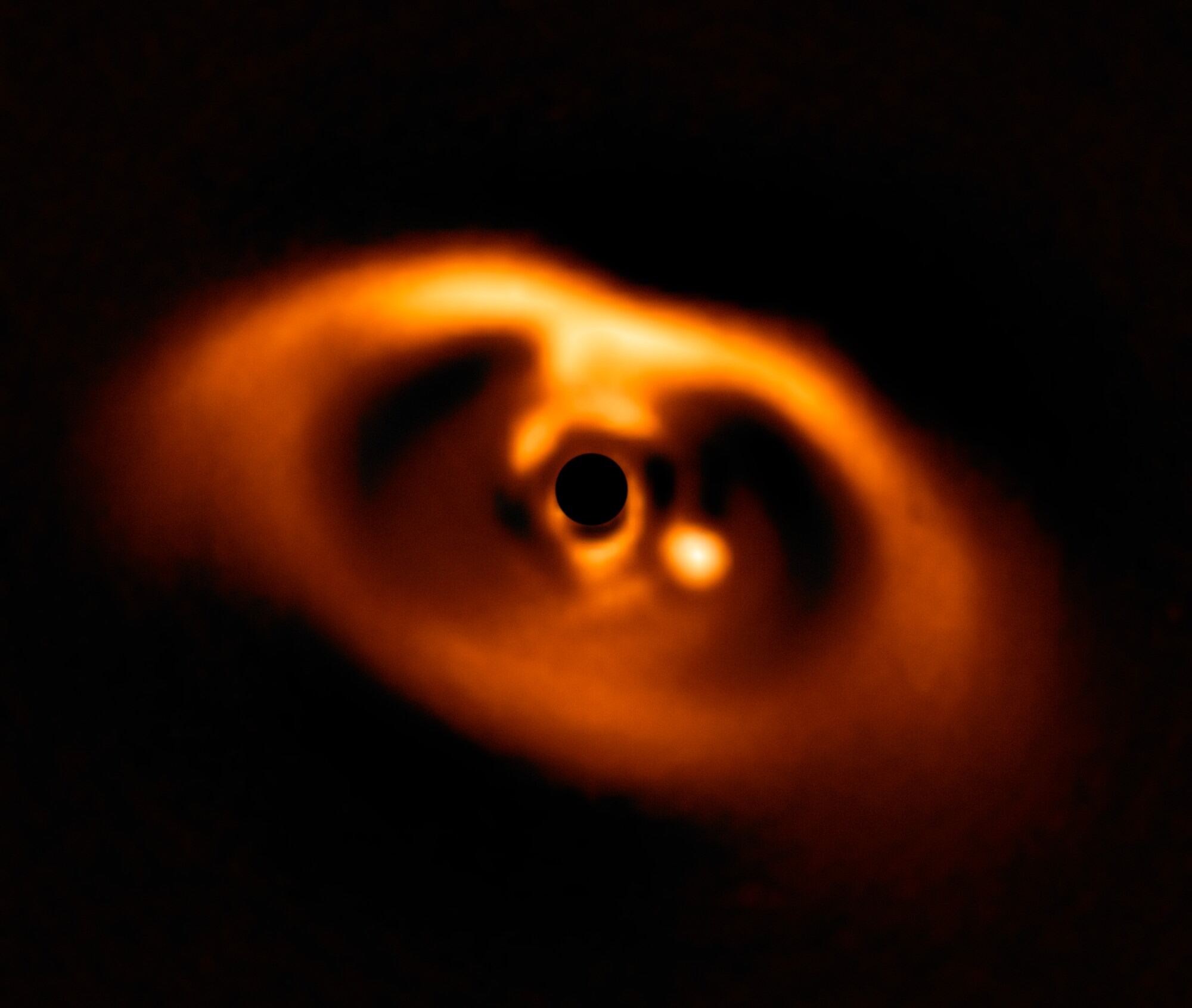
For their study, the team relied on the Keck Planet Imager and Characterizer (KPIC), a new instrument at the WM Keck Observatory, to obtain spectra of PDS 70b. This still-forming exoplanet orbits a young variable star (only about 5 million years old) located about 366 light-years from Earth. It is the only planet known to astronomers to have protoplanets located within the cavity of the circumstellar disk from which they formed, making it ideal for studying the formation and evolution of exoplanets in their birth environment. Jason Wang, an assistant professor of physics and astronomy at Northwestern University who advised Hsu, explained in a Northwestern News press release:
“This is a system in which both the planets and the materials from which they formed are still forming. Previous studies have analyzed this disk of gas to understand its composition. For the first time, we were able to measure the composition of the still-evolving planet itself and see how similar the materials on the planet are compared to the materials in the disk.”
Until recently, astronomers have not been able to directly examine a protoplanetary disk to track the birth of new planets. By the time most exoplanets can be observed with telescopes, their formation is complete and their birth disks have now disappeared. These observations are historic in that they are the first time scientists have compared information from an exoplanet, its birth disk and its host star. Their work was made possible by new photonics technologies that Wang helped develop for the Keck telescopes.
This technology allowed Hsu and his team to capture the spectra of PDS 70b and the faint features of this young planetary system, despite the presence of a much brighter star. “These new tools make it possible to capture really detailed spectra of faint objects alongside really bright objects,” Wang said. “Because the challenge is that next to a really bright star, there is a really faint planet. It is difficult to isolate the planet’s light to analyze its atmosphere.”
The resulting spectra indicated the presence of carbon monoxide and water in the atmosphere of PDS 70b. This allowed the team to calculate the inferred ratio of atmospheric carbon and oxygen and compare it with previously reported measurements of gases in the disk. “We initially expected that the carbon-oxygen ratio on the planet might be similar to that of the disk,” Hsu said. “Instead, we found that the carbon content relative to oxygen on the planet was much lower than the ratio in the disk. This was somewhat surprising and shows that our widely accepted picture of planet formation was oversimplified.”
Artist's impression of a protoplanetary disk in which planets form. Photo credit: ESO/L. Calcada
To explain this discrepancy, the team proposed two possible explanations. These include the possibility that the planet formed before its disk became enriched with carbon, or that the planet grew primarily by absorbing large amounts of solid materials in addition to gases. While the spectra only show gases, the team admits that some of the carbon and oxygen could come from solids trapped in ice and dust. Hsu said:
“For observing astrophysicists, a widely accepted picture of planet formation was probably oversimplified. According to this simplified picture, the ratio of carbon and oxygen gases in a planet's atmosphere should correspond to the ratio of carbon and oxygen gases in its natal disk—assuming the planet accumulates materials through gases in its disk. Instead, we found a planet whose carbon and oxygen ratio is much lower compared to its disk. Now we can confirm the suspicion that the picture of planet formation was oversimplified.”
“If the planet had preferentially absorbed ice and dust, that ice and dust would have evaporated before reaching the planet,” Wang added. “So it might tell us that we can't just compare gas to gas. The solid components could make a big difference in the carbon-oxygen ratio.” To further explore these theories, the team plans to obtain spectra from the other PDS 70c, the other young exoplanet in the system. “By studying these two planets together, we can better understand the formation history of the system,” said Hsu. “But it’s just a system. Ideally, we need to identify more of them to better understand how planets form.”
Further reading: Northwestern Now, The Astrophysical Journal Letters
Like this:
Load…

Comments are closed.