

Short note from Kip Hansen – December 30, 2024 – 650 words
At the end of the year I would like to mention an article from Shipping News.
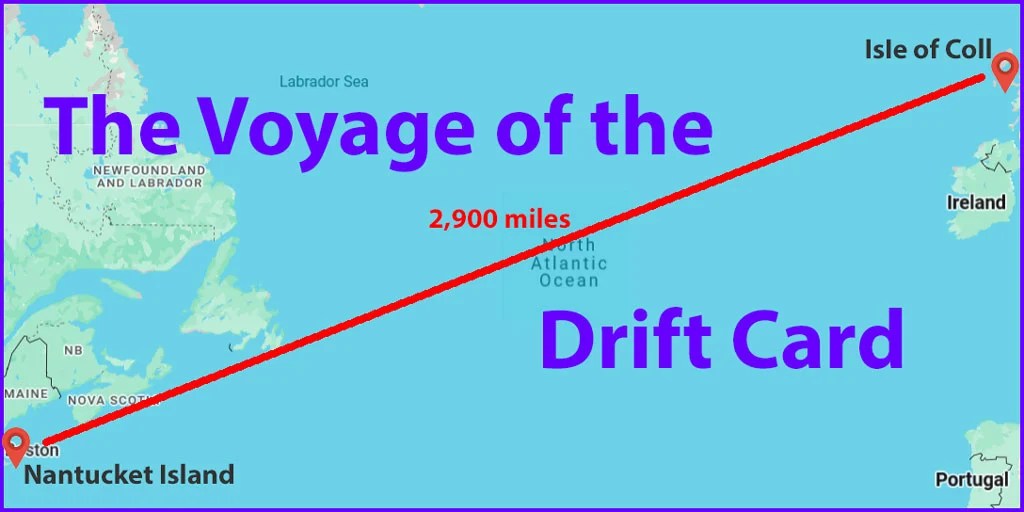
Five decades at sea: “Argo Merchant” map of the oil disaster appears on the Scottish island
“A plastic drift map of one of America's largest oil spills [the wreck of the Argo Merchant off of Nantucket Island in 1976] has turned up on a Scottish beach after almost five decades at sea.”
“While Barbara Payne was cleaning debris from her property on the Isle of Coll, Scotland, after a storm in October 2024, she found a red, credit card-sized plastic item with instructions in multiple languages to contact NOAA in Boulder, Colorado.”
This is a drift card: made of plastic, with raised lettering. This example has been at sea for 48 years and has traveled almost 3,000 miles. Somewhere on it is an identification number that allowed it to be traced to the location of the Argo Merchant disaster in 1976.
This isn't the only drift map that's been at sea for decades – a testament to its longevity and practicality.
NOAA drift maps found 45 years later
88,000 mile trip? Plastic card lands in Alaska after a 33-year voyage
So what do you think NOAA did after this success? According to NOAA, drift maps “were originally made of plastic, but [are] now thin, biodegradable pieces of wood colored with light, non-toxic paint.”
And when did they make the change? I couldn't figure it out. I tried, pretty hard. Even the famous Perplexity couldn't figure it out any further than I did and returned this:
“NOAA's Office of Response and Restoration (OR&R) has transitioned from using plastic drift cards to biodegradable wooden cards, but the exact date of this change is not explicitly stated in search results. However, we can conclude that this transition occurred sometime after the 1970s and before 2005. The search results show the following:
In the past, NOAA used plastic drift maps. For example, 48 years later, a plastic drift map released in 1976 near Nantucket, Massachusetts was recently found.
More recently, NOAA has been using “thin, biodegradable pieces of wood colored with light, non-toxic paint” as drift maps.
In 2005, during the Safe Sanctuaries pollution exercise in Florida, [wooden] Drift maps have already been used as part of the exercise.
The transition from plastic to wooden drift cards likely occurred gradually as environmental concerns about plastic pollution increased. NOAA made this change to reduce the impact of its studies on the environment because the wooden maps are biodegradable and painted with non-toxic paint. While we do not have an exact date for when NOAA completely phased out plastic drift charts in favor of wooden charts, it is clear that this change was implemented sometime between the late 1970s and early 2000s.”
In any case, until at least 1976, used plastic cards were replaced by wooden cards at an unknown date.
The claim and even the boast is that they are biodegradable. Painting with non-toxic paint is even more environmentally friendly. Biodegradability means that the drift cards are broken down at sea. The non-toxic paint guarantees that marine life, plants and animals will colonize the wooden cards and eat away and decompose the paint. For this reason, all boat “bottom paints” are toxic to some degree.
My question to the readers:
Is the new and improved biodegradable, non-toxic painted drift card likely to be an improvement over the 1970s style plastic cards?
# # # # #
Author's comment:
My opinion: NO. I could be wrong, but I don't think so.
If they no longer want drift maps to last for decades at sea, then at least the wooden maps would be no worse if they are still readable after their intended lifespan.
But if drift maps are intended for serious science, then I would have thought it far better to have them last as long as possible, still floating and in readable condition. To date, the record for a drift map is 48 years.
However, there was one [non-biodegradable] Fuel bottle found after 98 years.
Thanks for reading,
And may 2025 be a good year for you and your family.
# # # # #
Like this:
Load…
Related
Explore more from Watts Up With That?
Subscribe to receive the latest posts by email.

Comments are closed.