

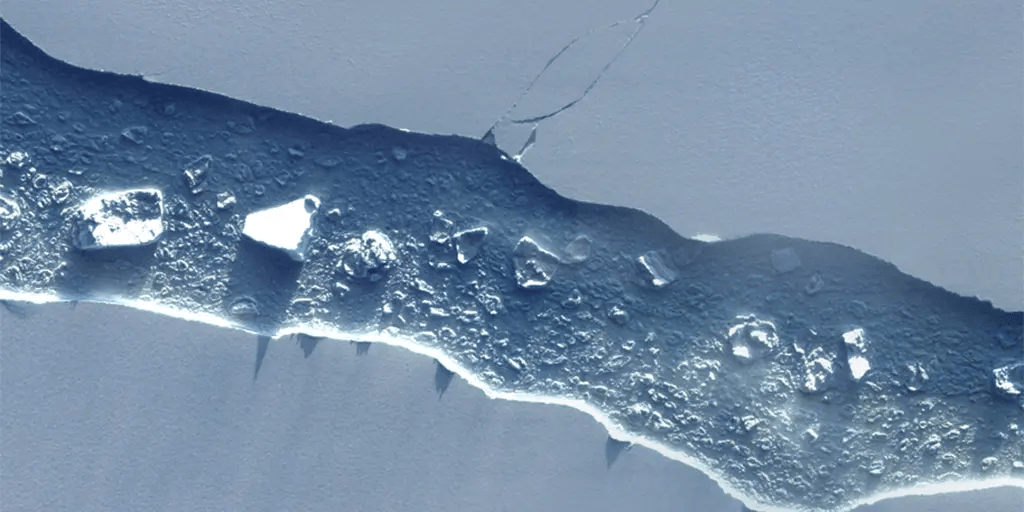
In July 2017, CNN and a number of other media outlets published reports about the calving of iceberg A-68 from Antarctica's Larsen C ice shelf. CNN said we should “panic” about it because of climate change. CNN was wrong. It was based on an incomplete understanding of iceberg formation and calving, driven by hasty judgment to advance the false narrative of climate catastrophe.
For example, CNN's John D. Sutter wrote in this article: This huge iceberg should freak you out. Here's why:
This does NOT look like climate change.
There is no disagreement among climate scientists about whether humans are warming the Earth by burning fossil fuels and polluting the atmosphere with greenhouse gases. We are. And we see the consequences.
Back then, the media's climate frenzy was blaming climate change, but today it looks like an Emily Litella moment has just occurred, as a new peer-reviewed scientific study says it wasn't anything unusual, and we shouldn't worry about it either. The new study, published in Geophysical Research Letters, throws cold water on these exaggerated media claims. The study, MacKie et al. (2024) analyzed 47 years of observational satellite data from Antarctica and found that there was no trend in annual maximum calving size in Antarctica between 1976 and 2023.
The main results of the study are:
- Satellite measurements have shown no discernible upward trend in the annual maximum iceberg area in Antarctica since 1973.
- The break-off of iceberg A-68 from the Larsen C ice shelf was not statistically significant.
- There could be calving events many times larger than anything observed in modern records, and yet this would not necessarily be due to climate change.
To be clear, the calving of the A-68 iceberg was “statistically not an exception” in the historical satellite records. Let that sink in. The authors write:
This result suggests that extreme calving events such as the recent Larsen-C iceberg A68 from 2017 are not statistically exceptional and that extreme calving events are not necessarily a consequence of climate change.
The authors also emphasize that calving of ice sheets and glaciers is an indication of a healthy cycle of glacier advance and retreat, rather than a signal that a glacier or ice sheet is unstable.
Our results therefore show that extreme calving events should not automatically be interpreted as a sign of ice shelf instability, but rather are representative of the natural cycle of advance and retreat of the calving front.
Based on the results of the generalized extreme value distribution (GEV) model used in the study, scientists also concluded that it is statistically possible for calving events to occur several times larger than anything previously observed in the satellite dataset. For example, the authors say: “A once-in-a-century calving event would result in an iceberg surface about the size of Switzerland.”
This is supported by other historical paleoclimate data and studies such as Bentley et al., 2005, which suggest that such extreme calving events have already occurred throughout the Holocene, which the authors note in their discussion.
In other words, the media made a big fuss about nothing.
Will this new study by MacKie et al. How do you refute the climate alarm? Noise in 2017 gets a lot of press? Probably not. It doesn't fit with the media's sensationalist narrative of impending climate doom. They would rather sweep this inconvenient truth under the rug than admit that they were not just wrong, but completely wrong.
Note: Hat tip to Chris Martz on Twitter for bringing this new study to my attention.
Anthony Watts
Anthony Watts is a senior fellow in environment and climate at the Heartland Institute. Watts has been in the weather business both in front of and behind the camera as an on-air meteorologist since 1978 and currently makes daily radio forecasts. He has developed weather graphics presentation systems for television and specialized weather instruments and is a co-author of peer-reviewed articles on climate issues. He runs the most viewed climate website in the world, the award-winning website wattsupwiththat.com.
Originally posted at ClimateREALISM
Like this:
Load…
Related
Explore more from Watts Up With That?
Subscribe to receive the latest posts by email.

Comments are closed.