

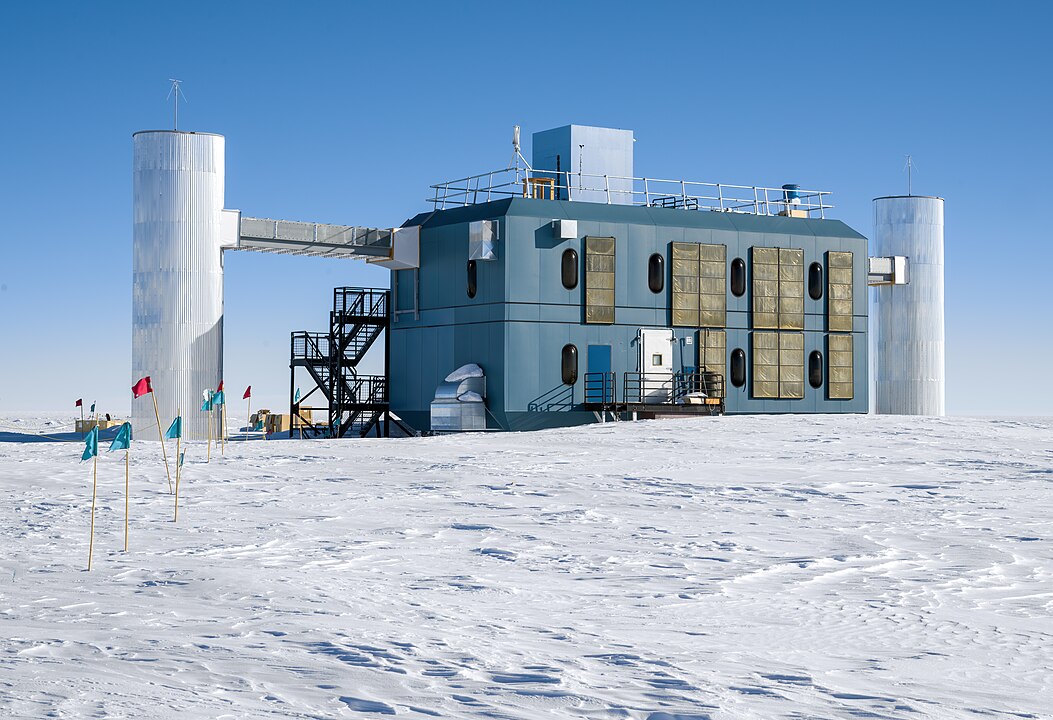
Neutrinos are tricky little nuisances that are difficult to observe. The IceCube Neutrino Observatory in Antarctica was built to detect neutrinos from space. It is one of the most sensitive instruments built with the hope of finding evidence of dark matter. Any dark matter trapped in the Earth would release neutrinos that IceCube could detect. To date and after ten years of searching, no excess neutrinos from Earth appear to have been found!
Neutrinos are subatomic particles that are light and carry no electrical charge. Certain events such as supernovae and solar events produce large amounts of neutrinos. The universe will now be teeming with neutrinos, trillions of which will pass through every human being every second. The challenge, however, is that neutrinos rarely interact with matter, making them difficult to observe and detect. As with other subatomic particles, neutrinos come in different types; Electron neutrinos, muon neutrinos and tau neutrinos, each associated with a corresponding lepton (an elementary particle with half-integer spin). The study of neutrinos of all kinds is key to understanding fundamental physical processes throughout the cosmos.
Chinese researchers are working on a new neutrino observatory called TRIDENT. They built an underwater simulator to develop their plan. Photo credit: TRIDENT
The IceCube Neutrino Observatory began collecting data in 2005 but did not begin full operation until 2011. It consists of over 5,000 football-sized detectors arranged in one cubic kilometer of ice deep underground. The detectors arranged in this way are intended to detect the weak flashes of Cherenkov radiation that are released when neutrinos interact with the ice. The location near the South Pole was chosen because the ice acts as a natural barrier against the Earth's background radiation.
A view of the IceCube Lab with a starry sky showing the Milky Way and green northern lights. Photo by: Yuya Makino, IceCube/NSF
Using data from the IceCube Observatory, a team of researchers led by R. Abbasi from Loyola University Chicago studied the nature of dark matter. This strange and invisible component of the universe is believed to account for 27% of the mass energy content of the universe. Unfortunately, dark matter does not emit, absorb or reflect light, making it undetectable by conventional means. One line of thought suggests that dark matter is made up of weakly interacting massive particles (WIMPs). They can be captured by objects such as the Sun, leading to their annihilation and transition into neutrinos. These are what the team was looking for.
The paper published by the team details their search for muon neutrinos from the center of the Earth within the 10 years of data collected by IceCube. The team primarily searched for WIMPs in the mass range of 10 GeV to 10 TeV, but due to the complexity and location of the source (the center of the Earth), the team relied on performing Monte Carlo simulations. The name comes from casinos in Monaco and involves running many random simulations. This technique is used where precise calculations cannot calculate the answer and therefore the simulations are based on the concept that randomness can be used to solve problems.
After running many simulations like this, the team found no excess neutrino flux compared to Earth's background levels. However, they conclude that although no evidence has yet been found, modernizing the IceCube observatory could yield more promising results, allowing it to study lower neutrino mass events and hopefully one day solve the mystery of the nature of dark matter.
Source: Search for dark matter from the center of the Earth with ten years of IceCube data
Like this:
Load…

Comments are closed.