

Astrophotography is a demanding art. Beyond the usual skills of understanding things like exposure, color balance, and the specifics of your equipment, there's the fact that stars are faint and move.
Technically, the stars don't move; the earth rotates. But to capture a faint object, you need a long exposure time. Typically between a few seconds and half a minute, depending on the level of detail you want to capture. In thirty seconds the sky will shift more than a tenth of a degree. This may not seem like much, but it's enough to make the stars blur ever so slightly. Many astrophotographers take multiple images and stack them to get even more detail, which would make the images even blurrier. It can create an interesting effect, but it doesn't produce a panorama of pinpoint stars.
The motion blur of the starlight created a shower of stars. Photo credit: Diana Juncher/ESO
Fortunately, there are numerous commercially available devices that can help you eliminate motion blur. You can attach tracking motors to your camera that move your image in time with the earth's rotation. They're incredibly precise, allowing you to shoot frame after frame for hours, with your camera always perfectly aligned with the sky. When you make a movie out of your images, the stars remain fixed while the Earth rotates beneath them.
Of course, most astrophotographers have the same limitations as almost everyone else. We are bound to the earth and can only view the stars through our sky ceiling. If we could rise above the atmosphere, we would have a clear view of the sky. A sky full of countless, non-twinkling stars. While astronauts often talk about this wondrous sight, photos of stars from orbit are often less spectacular. This is because of how difficult astrophotography is in space and it all boils down to motion blur.
The majority of astrophotography is done from the International Space Station (ISS). Since the ISS is in a relatively low orbit, it orbits the Earth once every 90 minutes. This means that the stars appear to be drifting 16 times faster than on Earth. A 30-second shot on the ISS has more motion blur than an eight-minute shot on Earth. For this reason, most photos from the ISS either show blurry stars or only show the brightest stars.
Don Pettit's Homemade Orbital Sidereal Tracker. Photo credit: Don Pettit
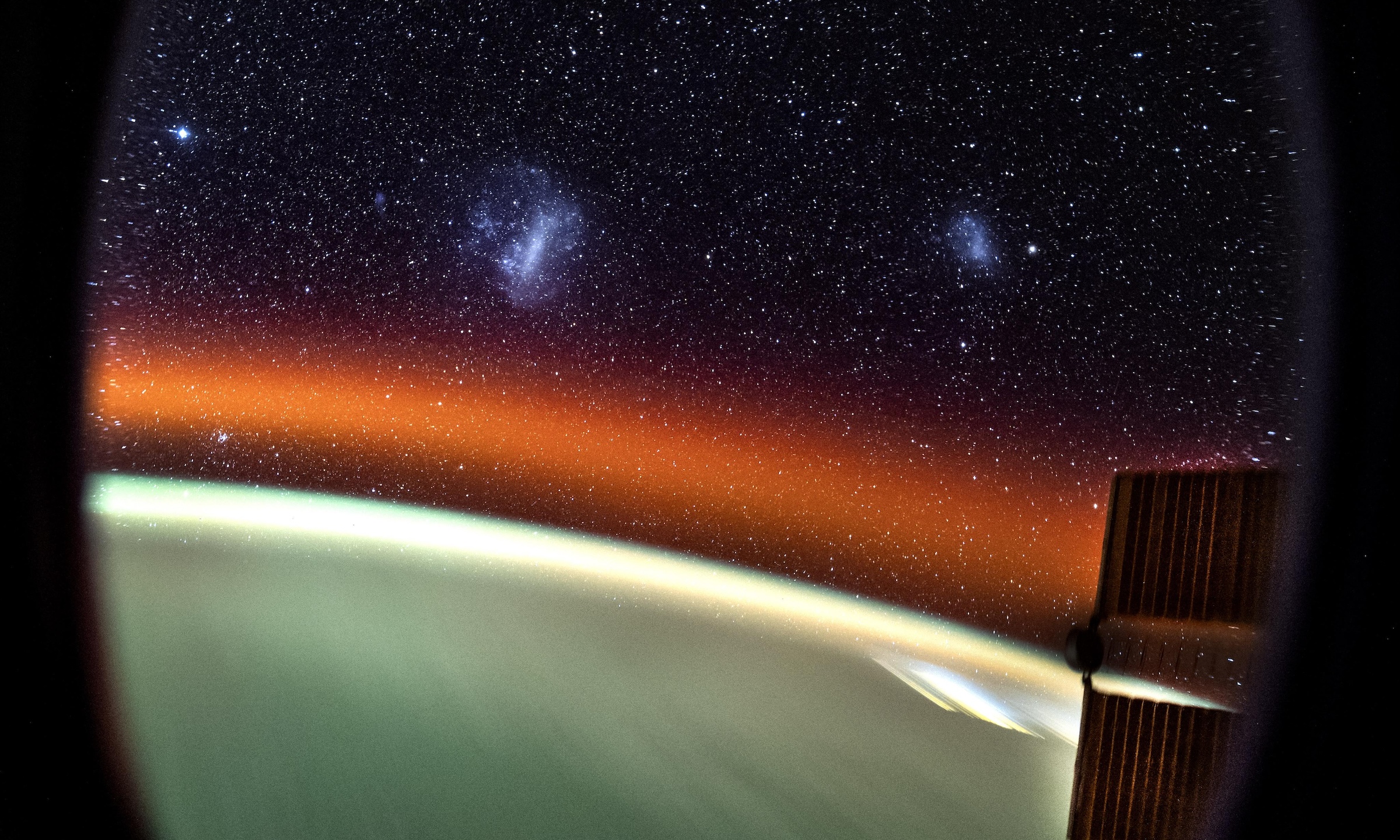
Ideally, an astronaut astrophotographer will bring a camera mount like those used on Earth. However, the market demand for such a mount is low, so you can't just buy it at the local camera store. You have to make your own, and that's exactly what astronaut Don Pettit did. Working with colleagues at RIT, he developed a camera tracker that moves 0.064 degrees per second and can be adjusted by 5%. With this mount, Don was able to capture 30-second shots with virtually no motion blur. His images rival some of the best earth-based images, but he takes them from space!
The level of detail in his photographs is unparalleled. For example, in the image above you can see the Large and Small Magellanic Clouds, rather than just blurry patches in the sky. Individual stars can be seen within the clouds. The image also provides an excellent view of an effect known as airglow. Molecules in the upper atmosphere are ionized by sunlight and cosmic rays, meaning this layer always glows faintly. No matter how skilled a terrestrial astrophotographer is, his images will always have a bit of that sparkle.
Airglow of various molecules in the upper atmosphere. Photo credit: NASA/Notes by Alex Rivest
But not Don Pettit. He is currently on the ISS and takes outstanding photos as a side hobby alongside his job. If you'd like to see more of his work, check him out on Reddit where he posts under the username astro_pettit.
Like this:
Load…

Comments are closed.