

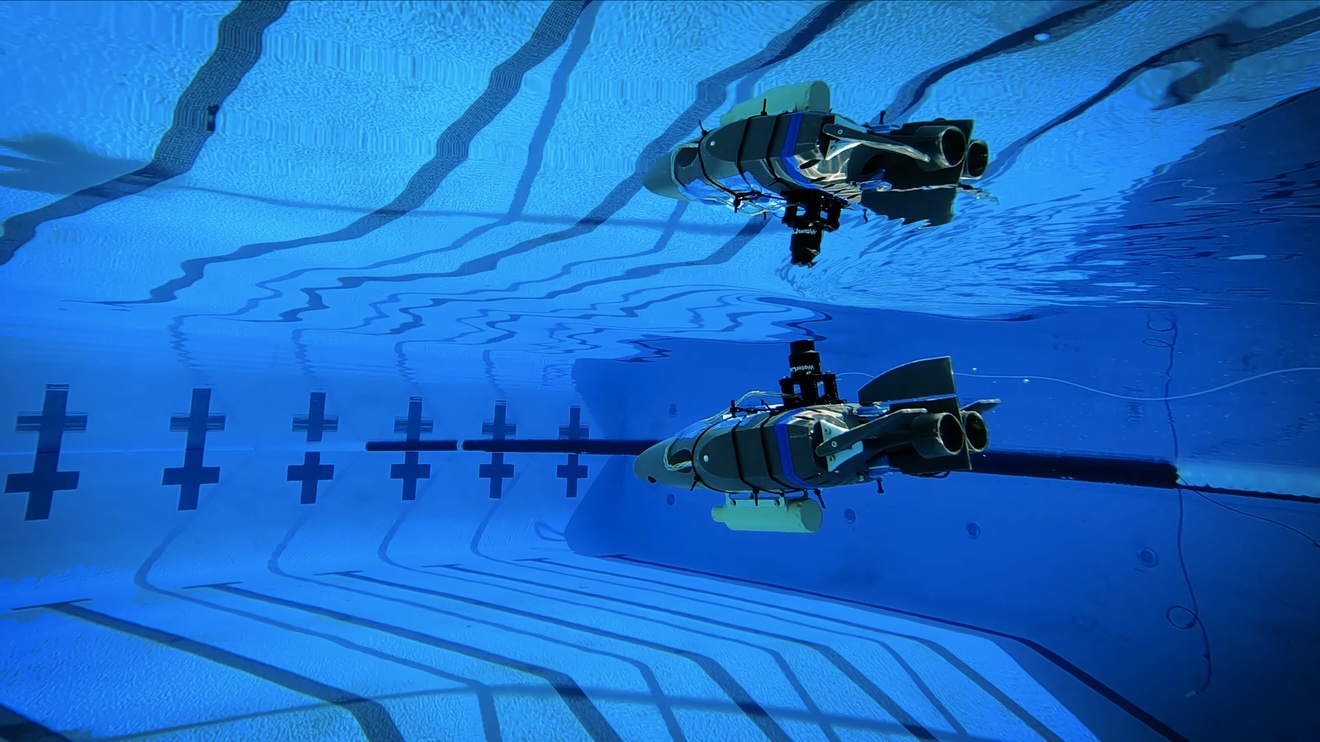
Europa, one of Jupiter's four Galilean satellites, is one of the most interesting places in the solar system to search for life. However, the subsurface oceans are buried under thick layers of ice, making exploration difficult. To explore its oceans, scientists have proposed using small swimming robots capable of penetrating the icy shell. Recently, NASA engineers tested prototypes that would function as a swarm, allowing them to explore the mysterious under-ice oceans on Europa and other icy worlds in the solar system.
Along with the other three Galilean satellites orbiting Jupiter, Europa was discovered by Galileo just over 400 years ago. With a diameter of just 3,120 km, it is the smallest of the four. It orbits Jupiter at a distance of 671,000 km in a nearly circular orbit. Compared to our own moon, Europa is slightly smaller, but that's where the similarities end. Europa is made of silicate rock and has a thick water ice crust, under which there is probably an ocean of liquid water. This has piqued the interest of scientists.
The Galilean moons of Jupiter: Io, Europa, Ganymede and Callisto. (Source: NASA/JPL-Caltech)
Europe's deep oceans may well harbor forms of aquatic life. Consider the deepest parts of the Earth's oceans, where entire ecosystems of thermal springs thrive. No sunlight penetrates these depths, so the organisms and creatures living there get all their energy from the heat that escapes from the interior of the planet. This is a tantalizing hint that such life may also have evolved in the oceans of Europe.
A black smoker hydrothermal vent discovered in the Atlantic Ocean in 1979. It is powered by magma deep beneath the surface, which superheats the water. The cloud transports minerals and other materials into the sea. Courtesy of USGS.
Exploration of Europe is already underway. NASA's Europa Clipper is expected to arrive in 2030. It will explore Europe with a powerful set of scientific instruments in a total of 49 flybys. With each pass, the instruments will look for signs that the ocean might harbor life beneath the thick ice crust. This will only be a flyby mission, exploring Europa high above its surface. NASA is already planning its next mission with even more complex robots that could probe the depths of Europa's subsurface oceans.
Artistic concept of a Europa Clipper mission. Image credit: NASA/JPL
This is where NASA’s new mission called SWIM “Sensing With Independent Micro-swimmers” comes into play. At least the concept is simple: a swarm of self-driving robots that can swim around in the subterranean oceans after being deployed by the ice-piercing Cryobot. Once underway, the floating robots, about the size of a cell phone, would search for chemical and temperature signals that could indicate life.
The swimming robots are not just on the drawing board. Engineers have already created prototypes using 3D printers, which have already been tested in a 23-meter pool. The devices, powered by two propellers with flaps for steering, were able to stay on course. However, these prototypes were slightly larger than the approximately three times larger prototypes intended for space flight.
The test results were very promising, but a lot of work still needs to be done before it is ready for the market. In the meantime, the robots will likely be tested here on Earth to support oceanographic research before being sent on their way to Europe.
Source: NASA Ocean World Explorers must swim before they can fly
Like this:
Load…

Comments are closed.