

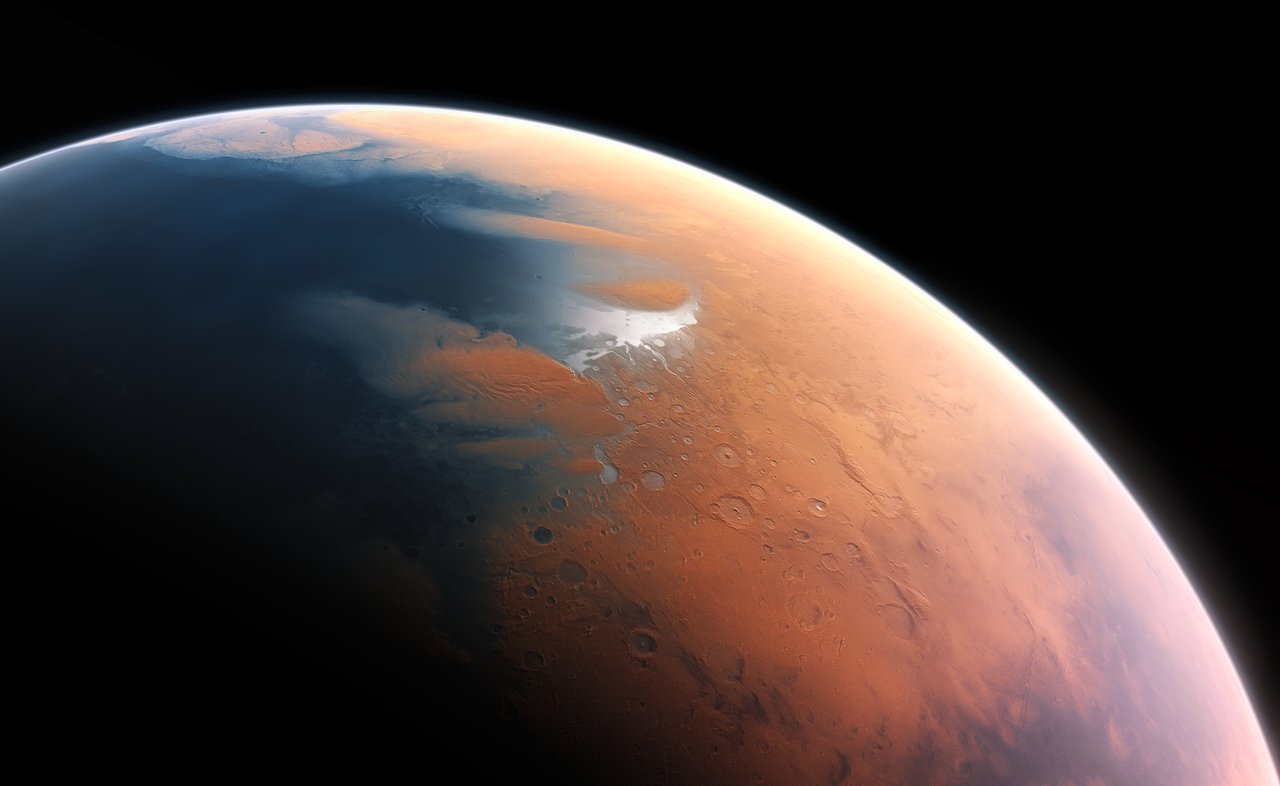
Earth and Mars were very similar when they were young. Four billion years ago, both planets had vast, warm seas. But while Earth retained its oceans, Mars' water evaporated or froze beneath its dusty surface. Exactly why these two worlds took such different paths is unclear, although it may have to do with the origin of their water.
Based on geological studies, we know that the Earth's water cycle appears to have stabilized early on. From about 4.5 billion years ago until today, water has been present on Earth in a stable manner. For Mars, things are less clear. Clay minerals cover about 45% of Mars' surface and date back to the so-called Noachian period, which is 4.1 to 3.7 billion years ago. We also see evidence of water flows between 3.7 and 3.0 billion years ago, in the so-called Hesperian Period. Mars appears to have been mostly dry during the Amazon period, which stretches from 3 billion years ago to the present. We have little evidence of Mars' earliest period, known as the Pre-Noachian. But a new study takes a look back at Martian time to give us a glimpse into Mars' first epoch, and it comes from a Martian meteorite called Black Beauty.
Black Beauty, or NWA 7034, is a Martian meteorite that is believed to have formed at a time when the Red Planet hosted a magnetic field. Photo credit: C Agee, Institute of Meteoritics, UNM; NASA
There are about 200 meteorites known to have come from Mars, and they are currently the only physical samples of Mars we have on Earth. One of the larger meteorites, Northwest Africa 7034, was discovered in Western Sahara in 2011 and is nicknamed “Black Beauty” because of its rich black coloring. It is made of material that is about 4.4 billion years old and contains more water than any other Martian meteorite. However, because it was ejected from Mars only 1.5 billion years ago, it is difficult to determine whether Black Beauty formed in a moist environment or whether it absorbed water during the Noachian or Hesperian periods.
This new study focuses not on Black Beauty as a whole, but on small zircon crystals embedded within it. These crystals can be dated to 4.48-4.43 billion years ago, meaning they were formed in the pre-Noachian period. What's interesting is that the crystals have layers of iron, aluminum and sodium in a pattern known as oscillatory zoning. Since zircon is of igneous origin, this type of banding is almost unknown in zircon crystals. There is only one place on Earth where such a pattern occurs, and that is in hydrothermal geysers like those in Yellowstone National Park.
The presence of these crystals in Black Beauty proves not only that Mars was wet during the pre-Noachian period, but also that it was geologically active and had warm thermal springs. Similar vents on Earth may have triggered the emergence of life on our world. Whether life ever existed on Mars is still an unanswered question, but it is clear that the conditions for life existed on Mars in its earliest history.
Reference: Gillespie, Jack et al. “Zircon trace element evidence for early hydrothermal activity on Mars.” Scientific Advances 110.47 (2024)
Like this:
Load…

Comments are closed.