

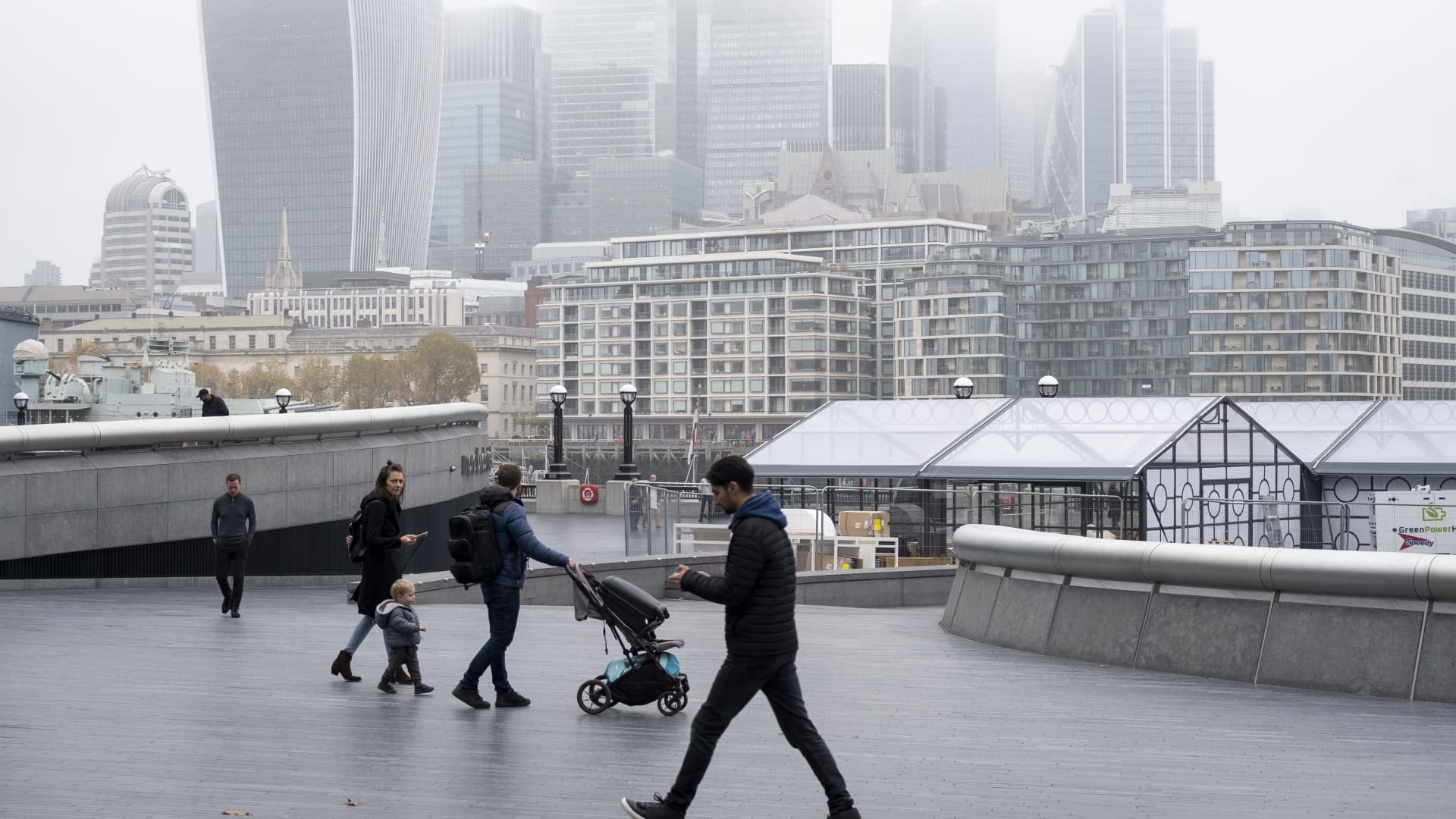
Bank of England in the City of London on November 6, 2024 in London, United Kingdom. The City of London is a city, formal county and local government district that hosts the main central business district (CBD) of London. The City of London is commonly referred to simply as the “City” and is also colloquially referred to as the “Square Mile”. (Photo by Mike Kemp/In Pictures via Getty Images)
Mike Kemp | In pictures | Getty Images
Early figures showed on Friday that Britain's economy suffered a surprise contraction in September and recorded only marginal growth in the third quarter after a strong recovery at the start of the year.
According to the Office for National Statistics, gross domestic product fell 0.1% in September, after growing just 0.2% the previous month. Economists polled by Reuters had expected growth of 0.2% in September.
In the entire third quarter, the British economy grew by just 0.1% compared to the previous quarter. That's below the 0.2% growth expected by economists and follows growth of 0.5% in the second quarter of the year.
Britain's dominant services sector also grew by just 0.1% quarter-on-quarter, the Office for National Statistics said. Construction rose 0.8% while production fell 0.2% for the month.
This comes after UK inflation fell sharply to 1.7% in September, falling below the Bank of England's 2% target for the first time since April 2021. The decline in inflation paved the way for the central bank to cut interest rates by 25 basis points on November 7, raising the key interest rate to 4.75%.
The Bank of England said last week it expects the Labor government's tax-hiking budget to boost GDP by 0.75 percentage points in a year. Policymakers also noted that the government's fiscal plan had led to an increase in their inflation forecasts.
British Finance Minister Rachel Reeves said on Friday she was “not happy” with the figures.
“In my budget I have made the difficult decisions to lay the foundations and stabilize our public finances. Now we will deliver growth through investment and reform to put more jobs and more money in people's pockets, get the NHS back on its feet, “Rebuild Britain and secure our borders in a decade of national Renewal,” she said in a press release.
Analysts cited the economy's underlying weakness and growing risks from geopolitical tensions as potential obstacles to further growth.
“It is clear that the economy has a little less momentum than we previously thought. And it is striking that the economy has only grown in two of the last six months,” said Ruth Gregory, deputy chief UK economist at Capital Economics.
“Overall, despite the decline in September, we still expect GDP growth to pick up in the coming quarters as the government's debt-financed spending boosts activity and the pressures of higher inflation and interest rates continue to ease,” Gregory added added.
According to Suren Thiru, economics director at the Institute of Chartered Accountants in England and Wales, a rate cut at the next BOE meeting in December now appears “unlikely”. He said inflation risks and increasing global headwinds would likely deter policymakers from implementing successive rate cuts.
“These numbers suggest that the economy was already faltering ahead of the budget release as weaker business and consumer confidence helped weaken output in the third quarter, particularly in September,” Thiru said in via Comments sent via email.
The outcome of the recent US elections has led to great uncertainty about the global economic impact of another term in office for President-elect Donald Trump. While Trump's proposed tariffs are expected to be largely inflationary and hit the European economy hard, some analysts believe such measures could present opportunities for the British economy.
Bank of England Governor Andrew Bailey last week gave little indication of the bank's views on Trump's tariff agenda, but cited risks related to global fragmentation.
“Let’s wait and see what happens next. “I’m not going to pre-judge what might happen and what might not happen,” he told reporters during a news conference.
The British pound By mid-morning, the U.S. dollar remained broadly unchanged against the U.S. dollar in London. The euro gained 0.4% against the pound following Friday's GDP release.

Comments are closed.