

Although there are no concrete plans for a manned mission to Mars, we all know one is coming. Astronauts regularly spend several months on the ISS, and we have learned a lot about the dangers astronauts face on long missions. However, Mars missions can take years, which poses a whole host of problems, including feeding the astronauts.
Nutrition can help astronauts manage spaceflight risks on the ISS, but long-duration missions to Mars are different. No subsequent delivery can be made.
From a physiological perspective, low gravity and radiation exposure are the two chronic dangers that astronauts face on the ISS. Low gravity can cause muscle wasting and loss of bone density, and radiation exposure increases the risk of developing cancer and other degenerative diseases. When astronauts make the journey to Mars, each leg of the journey can last six or seven months and they can stay on Mars for 500 days.
This dwarfs the eight days the Apollo 11 astronauts spent in space. These long journeys place a strain on astronauts' health, and NASA is working to understand the role nutrition can play in helping astronauts stay healthy and manage the risks.
Her current work on astronaut nutrition is freely available PDF book titled “Human Adaptation to Spaceflight: The Role of Food and Nutrition – 2nd Edition”. The four authors are all researchers working in this area Nutrition, biochemistry, biomedical research, space food systems and preventive health.
“The importance of nutrition in exploration has been documented time and again throughout history, on voyages across oceans, on expeditions across polar ice, and on treks across unexplored continents,” the authors write.
Scientists have learned a lot about nutrition since the age of sail and exploration, but the authors write that “a key difference between previous voyages and space exploration is that astronauts are unlikely to find food along the way.” This means that Understanding the nutritional needs of astronauts and the demands on the food system during long voyages “is as important to crew safety and mission success as any of the mechanical systems of the spacecraft itself.”
The book examines the unique challenges faced by astronauts and presents data from several studies consistent with these challenges. For example, nutritional research in Antarctica doubles the isolation and lack of sunlight that astronauts may face on long missions, and head-down bed rest doubles the musculoskeletal disuse they must endure.
This illustration shows how HDT bed rest is used as an analogue for astronauts during long-duration spaceflight in zero gravity. Image source: Hargens AR et al. 2016.
Astronauts face a long list of health risks during long-duration flights in space. The most well-known risks are radiation exposure and its risk of cancer, and weightlessness and its effects on muscles and bones. But there are also other, less well-known risks.
Astronauts can suffer from neuro-ocular syndrome, their immune systems can be weakened, and their intestinal biota can change. All of these diseases are related to diet. While scientists don't yet fully understand how it all works, it's clear that diet plays a role. The book describes the types of research conducted and the current state of knowledge. However, the authors are clear about one thing: the system for providing astronauts with the right nutrition must work.
ISS astronauts, with the exception of the Russians, receive some of their food in CSM (Crew Specific Menu) containers that each astronaut orders. They provide between 10 and 20% of their food. They also receive a small supply of fresh food and food with a limited shelf life on each resupply mission. This has increased the variety of foods for astronauts and improved nutrition, but astronauts still say they want more CSM and fresh foods.
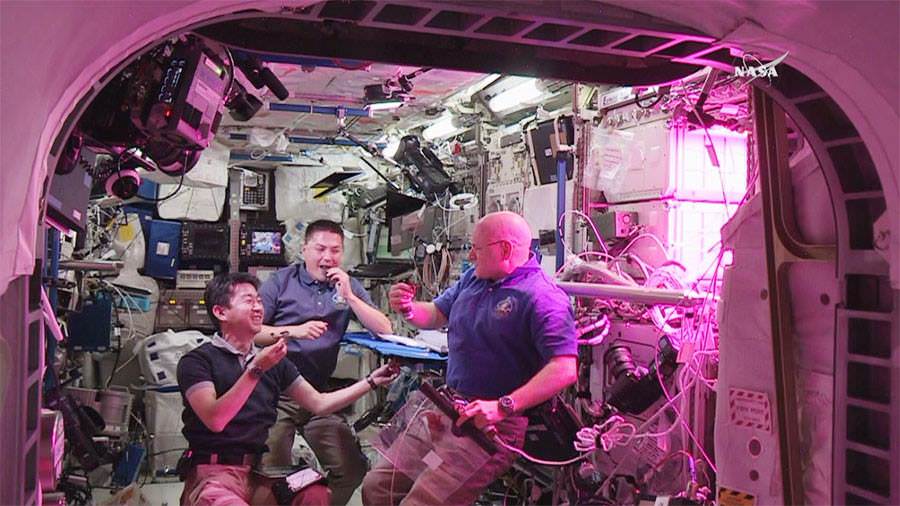
Here in the developed world on Earth, meeting nutritional needs is fairly easy. Most of us have access to supermarkets and/or farmers markets where we can purchase fresh produce and other healthy foods. The same diversity is simply not available in space. ISS astronauts have conducted experimental “farming” and successfully grown some food crops such as lettuce, kale and cabbage. However, this is still a long way from growing enough food to support nutrition, especially on a Mars mission where space and payload are likely to be at a premium.
Plants that have been successfully grown in the veggie sector include lettuce, chard, radishes, Chinese cabbage and peas. Photo credit: NASA
An obvious question about astronaut nutrition is whether supplements can replace nutritious foods. The authors present evidence that discredits this idea. “Many previous studies have shown that the complex synergistic benefits provided by whole foods cannot be reproduced by supplements,” they write. In fact, supplements can be dangerous in some cases. “Recent studies have also found that supplementation with certain antioxidants, such as vitamin E and vitamin A, may increase the risk of cancer and all-cause mortality,” the authors explain.
The need for a space food system goes beyond nutrition. There are also social and wellbeing benefits. Knowing you have access to a variety of healthy foods keeps morale up. The opportunity to share or trade high-quality food with your fellow astronauts can inspire goodwill and a desire to work together. Think about a meal together with friends or family and the social contacts this creates.
According to the authors, there is currently no solution to the nutritional hurdle for Mars missions. In fact, there is currently no system that can provide astronauts with the nutrition they need for a long spaceflight. “Currently, there is no food system that meets the nutritional, acceptability, security and resource challenges of extended exploration missions such as a mission to Mars,” the authors write.
But researchers say it's crucial that we develop one. Without them, long-duration missions and the astronauts who crew them will suffer and potentially face catastrophic failure.
“A space food system designed and deployed to meet all defined nutritional requirements should be available on every human mission as an essential countermeasure against health and performance declines,” the authors write.
Like this:
Load…

Comments are closed.