

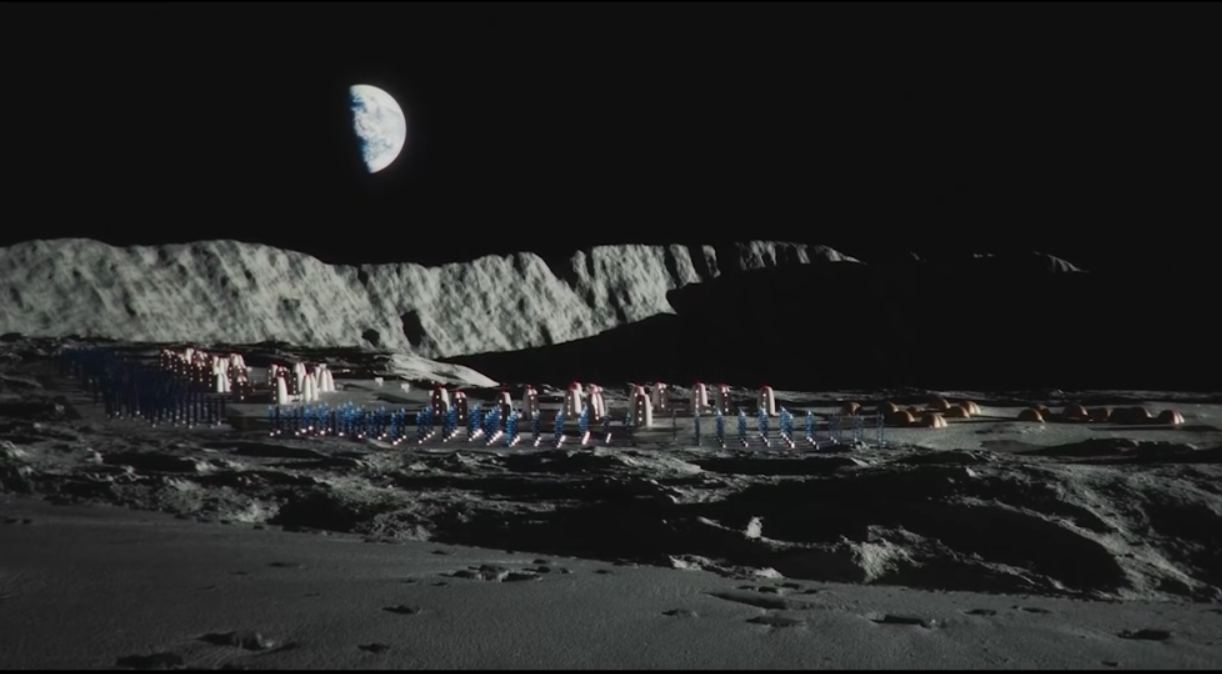
This decade and the next, several space agencies will send manned missions to the Moon for the first time since the Apollo era. These missions will culminate in the creation of permanent lunar infrastructure, including habitats, using local resources. In-situ resource utilization (ISRU). This includes lunar regolith, which robots will use to produce building materials using additive manufacturing (3D printing). These operations will leverage advances in teleoperation, where controllers on Earth will remotely control robots on the lunar surface.
The technology is one step closer to becoming a reality, according to new research from scientists at the University of Bristol. Through a virtual simulation, the team performed a sampling task and sent commands to a robot that mimicked the simulation's actions in real life. Meanwhile, the team monitored the simulation without the need for live camera streams, which are subject to a communication delay on the Moon. This project impressively shows that the team's method is well suited for teleoperations on the lunar surface.
Through NASA's Artemis program, ESA's Moon Village and the Chinese Lunar Exploration Program (Chang'e), space agencies, research institutes and commercial space companies are exploring how to extract valuable resources from lunar regolith (also known as lunar dust). . These include water and oxygen, which can be used to meet astronauts' basic needs and to produce liquid hydrogen and oxygen as propellants. Remote handling of regolith will be critical to these activities because lunar dust is abrasive, electrostatically charged, and difficult to handle.
The teleoperated robot used by the University of Bristol research team (1 of 2) Photo credit: Joe Louca
The team consisted of researchers from the University of Bristol's School of Engineering Mathematics and Technology, who conducted the experiment at the European Space Agency's European Center for Space Applications and Telecommunications (ESA-ESCAT) in Harwell, UK. The study describing their experiment was presented at the 2024 International Conference on Intelligent Robots and Systems (IROS 2024) in Dubai and published in the research journal of the Institute of Electrical and Electronics Engineers (IEEE).
Lead author Joe Louca, a Doctor of Philosophy at the School of Engineering Mathematics and Technology in Bristol, explained:
“One possibility could be for astronauts to use this simulation to prepare for upcoming lunar exploration missions. We can adjust the strength of gravity in this model and provide haptic feedback so we can give astronauts a sense of how moon dust would feel and behave under lunar conditions – which has one-sixth the gravitational pull of Earth. This simulation could also help us operate lunar robots remotely from Earth, thereby avoiding the problem of signal delays.”
The virtual model created by the team could also reduce the costs associated with developing lunar robots for institutes and companies researching this technology. Traditionally, lunar construction experiments have required the creation of simulants with the same properties as regolith and access to advanced facilities. Instead, developers can use this simulation to conduct initial testing on their systems without incurring these expensive costs.
The teleoperated robot used by the University of Bristol research team (2 of 2) Photo credit: Joe Louca
Looking forward, the team plans to explore the potential non-technical barriers to this technology. This also includes how people interact with this system, with communication having a round-trip time of 5 to 14 seconds. This is expected for the Artemis missions, in contrast to the 3 second delay that occurred on the Apollo missions due to increased delays in the Deep Space Network (DSN). Louca said:
“The model predicted the outcome of a regolith simulant scooping task with sufficient accuracy to be considered effective and trustworthy 100% and 92.5% of the time. Over the next decade, we will see several crewed and uncrewed missions to the Moon, such as NASA's Artemis program and China's Chang'e program. This simulation could be a valuable tool to support the preparation or operation of these missions.”
Further reading: University of Bristol
Like this:
Load…

Comments are closed.