

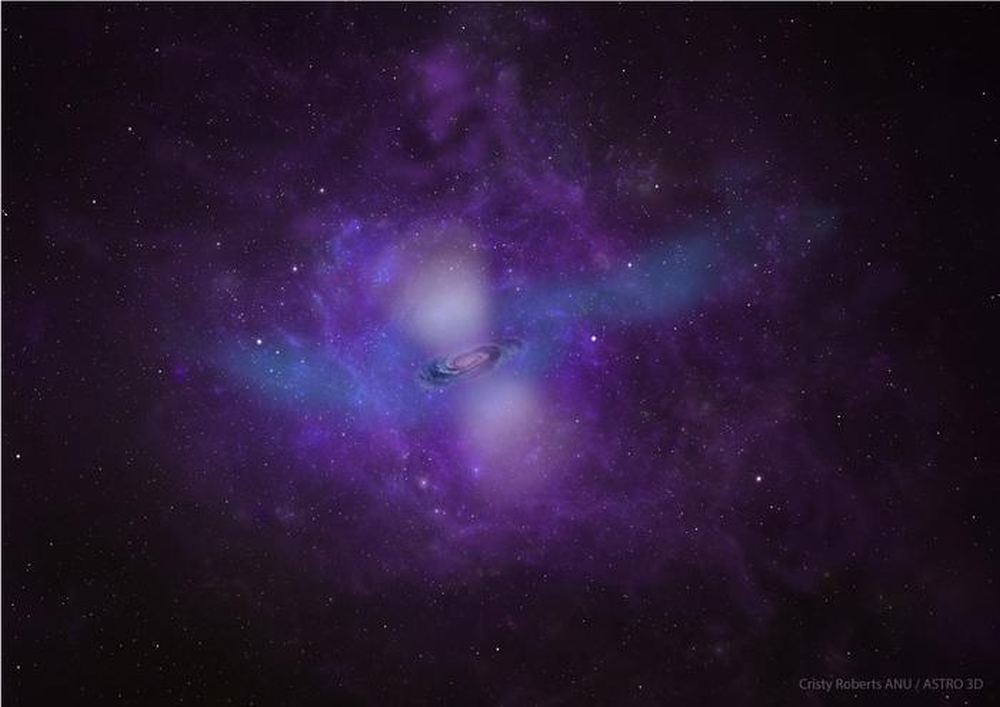
If you ask most people what a galaxy is made of, they will say it's made of stars. Our own galaxy, the Milky Way, is home to between 100 and 300 billion stars, and we can see thousands of them with the naked eye. But most of a galaxy's mass is actually gas, and the amount of that gas is difficult to measure.
Researchers have found a way to see how far this gas extends into the cosmos.
One of the fundamental questions about galaxies concerns their size. For example, if we restrict our observations to stars, our galaxy is about 26.8 kiloparsecs across, or about 87,000 light-years. Our neighbor, Andromeda, is about 46.56 kpcs across, or 152,000 light-years. But do these measurements really define the sizes?
In a new study published in Nature Astronomy, researchers have measured the reach of gas extending beyond a galaxy's stellar population. The study is titled “An emission map of the disk-circumgalactic medium transition in the starburst IRAS 08339+6517.” The lead author is Nikole Nielsen, a researcher at Swinburne University and ASTRO 3D and an assistant professor at the University of Oklahoma.
Galaxies have gaseous halos that act as reservoirs for star-forming material, called the circumgalactic medium (CGM). The CGM borders the intergalactic medium (IGM), which is made up of even more gas that exists between galaxies. The CGM is notoriously difficult to observe because it is so diffuse and extended. But it makes up about 70% of a typical galaxy (ignoring dark matter) and plays an important role. “This diffuse reservoir of gas, the circumgalactic medium, acts as an interface between a galaxy and the cosmic web that connects galaxies,” the authors explain in their paper.
Astronomers rely on bright background objects to observe the CGM. Things like distant quasars, pulsars, or other galaxies can make the gas glow and allow astronomers to measure its spectra. But this only works if things are aligned correctly, and it only produces a ray-like image of the galaxy.
In this new research, a team of astronomers found a different way to observe the CGM. They used the Keck Cosmic Web Imager (KCWI) on the 10-meter Keck telescope in Hawaii to observe the gas around IRAS 08339+6517. Instead of a limited, beam-like view of the gas, they were able to see the clouds of gas far outside the typical boundaries of a galaxy, up to 100,000 light-years beyond the limit of starlight that normally defines a galaxy.
“We present integral-field spectroscopy of kiloparsec-resolution emission lines tracing cool ionized gas from the center of a nearby galaxy to 30 kpcs into its circumgalactic medium,” the authors write. In their paper, they explain that “…we obtain the equivalent of thousands of quasar lines of sight around a single galaxy.”
IRAS 08339+6517 is a starburst galaxy located about 56 kpcs away. A starburst galaxy is a galaxy that produces stars at an exceptionally high rate. Hubble images show that it is a face-on spiral galaxy, with 90% of its starlight contained within a radius of about 2.4 kpcs. “In contrast to normal spirals, it has quite extreme properties, with a star formation rate (SFR) = 12.1 solar masses per year, about 10 times higher than typical for its mass, and stellar populations dominated by very young (about 4 – 6 million years) stars,” the authors write.
The researchers found that the physical properties of the hydrogen and oxygen in the gas changed as the CGM expanded beyond the galaxy. The change was pervasive at a certain distance, suggesting that the gas interacts with different energy sources.
“We found it everywhere we looked, which was really exciting and kind of surprising,” said lead author Nielsen. “We're now seeing where the galaxy's influence stops, the transition where it becomes part of more of what surrounds the galaxy, and finally where it joins the larger cosmic web and other galaxies. These are all normally blurred boundaries.”
“But in this case, we seem to have found a fairly clear boundary in this galaxy between its interstellar medium and its circumgalactic medium,” said Professor Nielsen.
“In the CGM, the gas is heated by something other than the typical conditions within galaxies; this probably includes heating from diffuse emissions from the community of galaxies in the Universe, and possibly shocks also contribute,” said Dr. Nielsen.
The boundary is where the gas inside the galaxy is heated differently than outside the galaxy. Within the disk of the galaxy, the gas is photoionized by HII star formation regions (ionized atomic hydrogen). At greater distances, the gas is ionized by shock waves or the extragalactic UV background.
“This interesting change is important and provides some answers to the question of where a galaxy ends,” she says.
This research figure shows the spatial distribution of the ionized gas in the CGM on kiloparsec scales. Emissions from [Oiii] ?5007 in the CGM of IRAS08 extends to at least 30 kpc from the galaxy center. The blue rectangle represents the field of view of the KCWI covering the galaxy disk (emission map not shown). HI contours indicate levels of constant HI column density from the Very Large Array, where a filament from IRAS08 extends toward a smaller companion galaxy 60 kpc away. Image credit: Nielsen et al. 2024.
These results contribute to one of the most interesting topics in astronomy: How do galaxies evolve?
Gas flows into galaxies and becomes fuel for further star formation. At the same time, gas flows out of a galaxy as part of the stellar feedback. There are three major types of galaxies: starburst galaxies with extreme star formation, quenched galaxies with very little star formation, and galaxies in between. The gas in the CGM and the IGM plays a role in the gas budget of a galaxy.
IRAS08 exhibits a remarkably strong outflow of gas, but its metallicity profile is flat and shallow. Astronomers typically assume that galaxies with these metallicities and high SFRs accrete significant amounts of gas. Other scientific observations of IRAS08 indicate “a rapid inflow of gas into the center of the disk, driving the very strong starburst and subsequent strong outflows,” the authors explain.
Gas flows into galaxies along spiral filaments. This image of a galaxy shows a stream of incoming gas as calculated by a supercomputer. Image credit: MPIA (G. Stinson / AV Maccio)
However, IRAS 08 is a complex object that also interacts with a nearby galaxy. “VLA observations of the HI gas around IRAS08 identified a filament that extends to a distance of about 40 kpcs from the galaxy and contains 70% of the neutral gas in the system,” the authors write. This filament interacts with a neighboring galaxy about 60 kpcs away that has only one-tenth the mass of IRAS-08.
The authors say that this interaction with its neighbor could promote star formation, but there is no evidence that it affects IRAS-08's morphology. This does not appear to be the first phase of an eventual merger.
Finding the boundary between CGM and IGM could be a crucial step in understanding gas circulation in and out of galaxies and how gas can interact with neighbors without merging.
“The circumgalactic medium plays a big role in this cycling of gas,” says Dr. Nielsen. “Now that we understand what the CGM looks like around galaxies of different types – those that are forming stars, those that are no longer forming stars, and those that are in transition between the two – we can observe differences in this gas that may be causing the differences within the galaxies themselves, and changes in this reservoir could actually be causing the changes in the galaxy itself.”
Nature has few discrete boundaries. Everything interacts with other things, including massive galaxies. The interactions are the key to understanding.
These results could provide completely new insights into the interaction between galaxies, gas and stars, as well as into the evolution of galaxies.
Like this:
Load…

Comments are closed.