

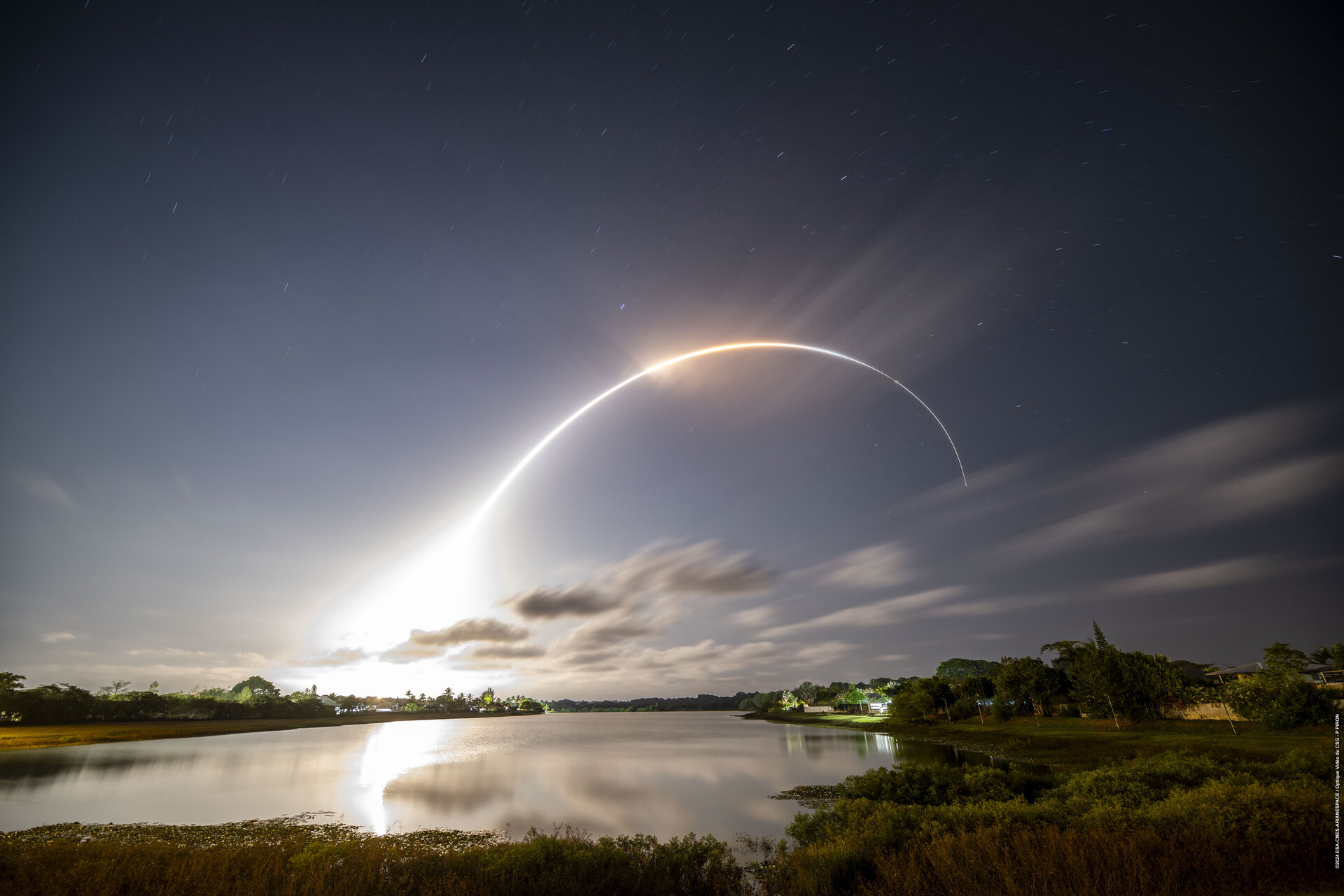
The European Space Agency (ESA) launched its final Vega rocket this week, placing a Sentinel-2C Earth observation satellite into orbit, completing 12 years of service and 20 successful flights for the venerable Vega. The rocket launched several well-known missions, including LISA Pathfinder (2015), the Proba-V (2013) and Aeolus (2018) Earth observation satellites. ESA will now launch these types of payloads with the new Vega-C rocket, which can carry heavier payloads at a lower cost.
Vega's final launch was on September 5, 2024, from Europe's spaceport in French Guiana, and ESA said it would accelerate the rocket enough to put one of the Sentinel satellites into orbit, after Vega had already launched Sentinel-2A in 2015 and Sentinel-2B in 2017.
Vega was a smaller but powerful rocket launcher designed to carry smaller science and Earth observation satellites into orbit. It specialized in launching satellites into polar orbits. The rocket was 30 meters tall and weighed 137 tons on the launch pad. Vega consisted of three solid-fueled stages and a liquid-fueled fourth stage before the liquid-fueled fourth stage took over the task of launching the satellites into the desired orbit. Vega could reach space in just six minutes.
On 13 February 2012, the first Vega launched on its maiden flight from Europe's South American spaceport in French Guiana, deploying nine scientific satellites. Image credit: ESA – S. Corvaja
The first launch of Vega took place in February 2012. It was a perfectly executed qualification flight to deploy nine scientific Cubesats into Earth orbit.
Vega's second flight in 2013 added a secondary payload adapter called Vespa, which offered various payload sharing options where multiple satellites could be launched on one rocket. This flight launched three satellites into orbit – Earth observation satellites, ESA's Proba-V, Vietnam's VNREDSat-1A and Estonia's first satellite, the technology demonstrator ESTCube-1. All three were launched into different orbits and the complex mission required five upper stage launches, with the flight lasting about twice as long as the first launch.
Countdown and takeoff of Vegas' last flight.
The most satellites Vega has ever put into orbit was achieved in 2020, when a variant of Vespa – called the Small Spacecraft Mission Service – was used to put over 50 satellites into orbit simultaneously.
2015 was Vega's busiest year. Three ESA missions were launched, including a reentry demonstrator called IXV, which demonstrated the technology needed to launch a vehicle into space and return it safely to Earth. According to ESA, Vega IXV accelerated to a speed of 27,000 km/h (16,777 mph) at an altitude of 412 km (250 miles) in less than two hours before the reentry vehicle splashed down in the Atlantic Ocean.
But now ESA is building on the legacy of Vega, and the era of Vega-C has already begun. This new rocket made its maiden flight in July 2022, carrying the main payload LARES-2 – a scientific mission from the Italian space agency ASI – as well as six research CubeSats from France, Italy and Slovenia into orbit. According to ESA, Vega-C will offer better performance and greater payload capacity as it features two new solid propulsion stages, an improved fourth stage, a newly developed fairing and new ground infrastructure.
Launch of a Vega-C rocket carrying the Lares-2 mission and rideshares. Image credit: ESA
Like this:
Load…

Comments are closed.