

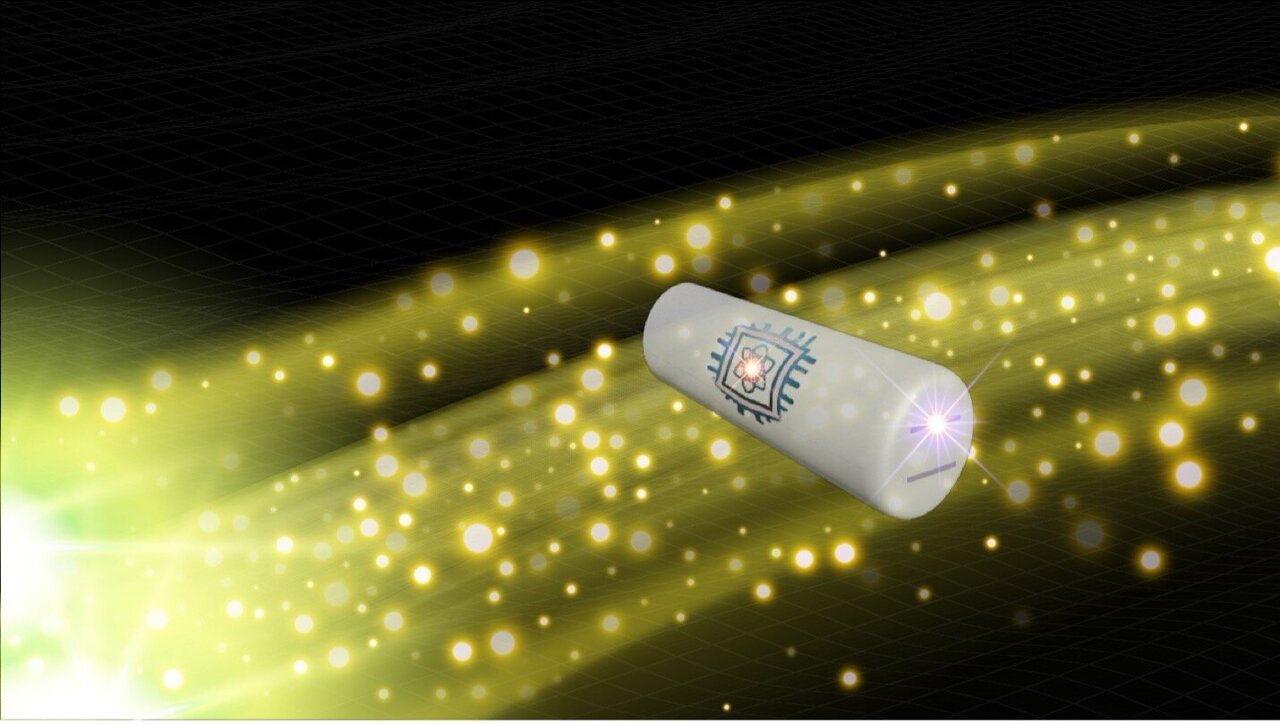
There are four fundamental forces in the universe: strong, weak, electromagnetic and gravitational. Quantum theory explains three of the four forces through the interaction of particles, but science has not yet discovered a corresponding particle for gravity. The hypothetical gravitational particle, known as a “graviton,” is thought to generate gravitational waves, but has not yet been detected in gravitational wave detectors. A new experiment aims to change that by using an acoustic resonator to identify individual gravitons and confirm their existence.
The four fundamental forces of nature govern the universe. Gravity is known to many people, but we don't fully understand how it works. However, its effects are obvious as a force of attraction between objects with mass. It keeps the planets in orbit around the sun, the moon in orbit around the earth, and us stuck to the surface of planet earth. One of the first attempts to describe it was by Isaac Newton, who stated that gravity was proportional to the mass of objects and inversely proportional to the square of the distance between them. Even on the largest scale of the cosmos, it seems to be essential to the structure of the universe.
Portrait of Newton in 1702, painted by Godfrey Kneller. Source: National Portrait Gallery, London
One of the challenges with gravity is that, unlike the other fundamental forces, it can only be explained in the classical sense. Quantum physics can explain the other three forces in terms of particles; the electromagnetic force has the photon, the strong nuclear force has the gluon, the weak nuclear force has the W and Z bosons, but gravity has, well, nothing yet. Except for the hypothetical graviton. The graviton can be thought of as the building block of gravity, just as bricks are the building blocks of a house or atoms are the building blocks of matter.
Detectors like LIGO, the Laser Interferometer Gravitational-Wave Observatory, can detect gravitational waves from large events like the merger of black holes and neutron stars. So far, however, no graviton has been detected. But that could soon change. A team of researchers led by physics professor Igor Pikovski of the Stevens Institute of Technology is proposing a new solution. Using existing detection technology, which is essentially a heavy cylinder called an acoustic resonator, the team proposes adding improved methods for detecting energy states, called quantum sensing.
LIGO Observatory
The proposed solution, explains Pikovski, “is similar to the photoelectric effect that led Einstein to the quantum theory of light, except that gravitational waves replace electromagnetic waves.” The secret lies in the discrete energy steps exchanged between the material and the waves when individual gravitons are absorbed. The team will use LIGO to confirm gravitational wave detections and match them with their own data.
The new approach was inspired by gravitational wave data detected on Earth. The waves detected in 2017 came from a collision event between two city-sized superdense neutron stars. The team calculated the parameters that would facilitate the absorption probability for a single graviton.
The team began thinking about a possible experiment. Using data from gravitational waves that had previously been measured on Earth, such as those that arrived in 2017 when two Manhattan-sized (but super-dense) distant neutron stars collided, they calculated the parameters that would optimize the absorption probability for a single graviton. Their development led to devices similar to the Weber rod (thick, heavy, 1-ton cylindrical rods) that can detect gravitons.
The rods would be suspended in the newly developed quantum detector, cooled to the lowest possible energy state, and set into vibration by the passage of a gravitational wave. The team then hopes to measure the vibration using highly sensitive energy detectors to see how the vibrations change in discrete steps, indicating a graviton event.
These are exciting times for gravity-based physics and we are definitely getting closer to unlocking its secrets. Unfortunately, the highly sensitive detectors are not yet available, but according to Pikovski's team, they are not far away. Pikovski summed it up: “We know that quantum gravity is still unsolved and too difficult to test in its full glory, but we can now take the first steps, just as scientists did with light quanta over a hundred years ago.”
Source: New research suggests a way to capture physicists' most sought-after particle – the graviton
Like this:
Load…

Comments are closed.