

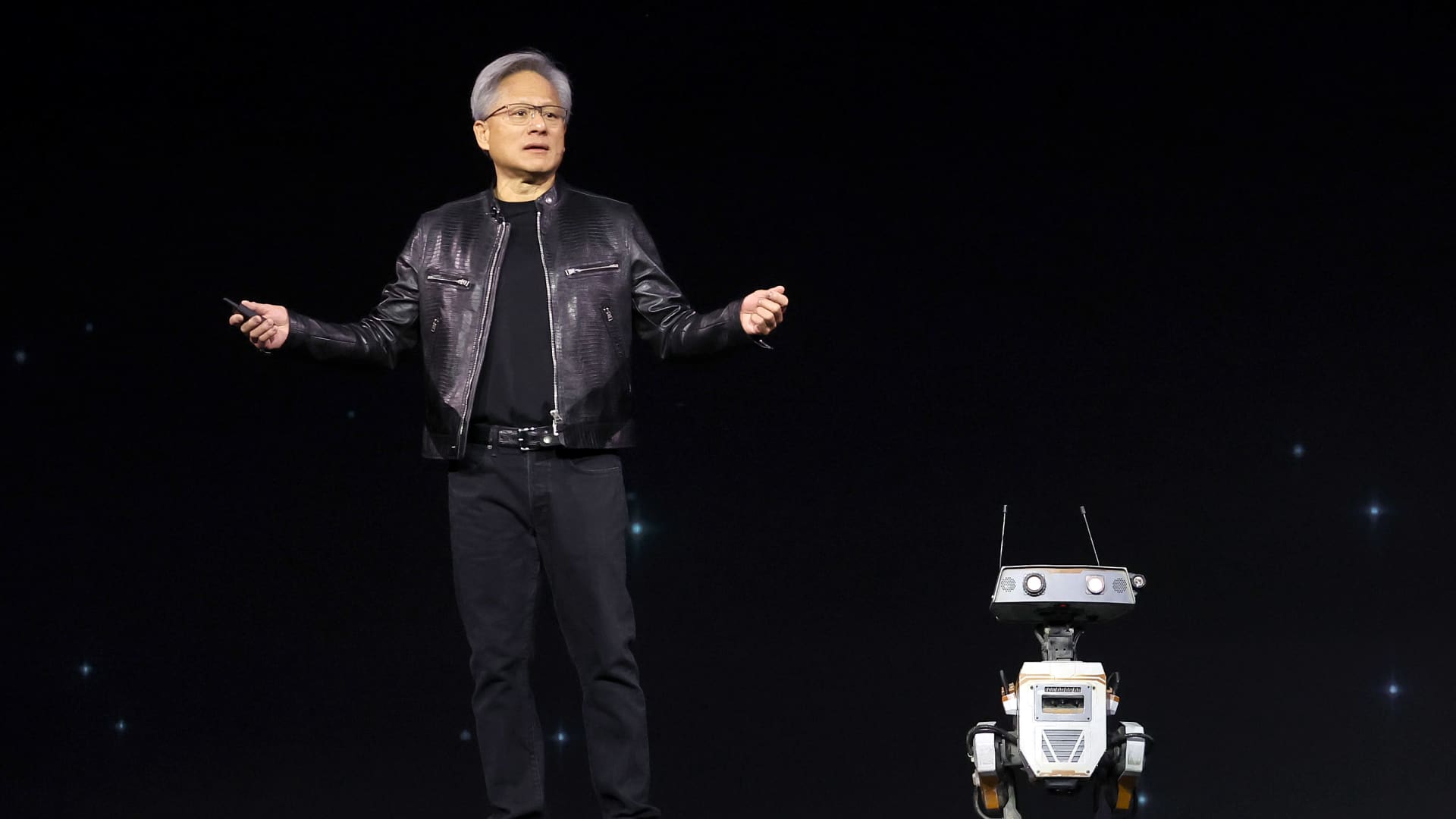
Nvidia CEO Jensen Huang delivers a keynote speech during the Nvidia GTC Artificial Intelligence Conference at the SAP Center on March 18, 2024 in San Jose, California.
Justin Sullivan |
NVIDIA On Wednesday, the company reported its fourth consecutive quarter of triple-digit revenue growth, beating estimates for both revenue and earnings. It also issued a forecast that beat Wall Street expectations. The company even strengthened its buyback program with a plan to buy back $50 billion worth of shares.
However, the stock fell by 7% during further trading.
That's life for Nvidia, which has reached a $3 trillion market cap on the artificial intelligence boom, has grown nearly ninefold since the end of 2022, and is surpassing every publicly traded company except Apple in valuation. (It surpassed Apple at one point in June.)
Nvidia not only reported annual revenue growth of 122% to over $30 billion on Wednesday, but also said revenue in the current period would rise by about 80% to around $32.5 billion. Analysts had expected just under $32 billion.
However, Bernstein analyst Stacy Rasgon told CNBC before the report came out that rumors on the buyer side were more likely to be in the $33 billion to $34 billion range. This means that Nvidia would have to significantly exceed analyst estimates in its forecast to experience a rebound.
Rasgon, who recommends buying shares of the chipmaker, said there are no signs that demand for Nvidia's graphics processing units (GPUs), the core infrastructure for developing and running AI models, is slowing.
“There's still a huge demand,” Rasgon said on CNBC's “Closing Bell.” “They're still shipping everything they can sell.”
Nvidia expects Blackwell sales to be “multi-billion dollars” in its fiscal third quarter, which ends in October. Blackwell is the company's latest generation of technology after Hopper. There had been some concern that Blackwell could face delays, but Chief Financial Officer Colette Kress said on a conference call with analysts that “supply and availability have improved.”
Still, “demand for Blackwell platforms clearly exceeds supply and we expect it to continue that way into the next year,” Kress said.
Aside from the lack of whisper numbers, some investors may be paying attention to Nvidia's gross margin, which declined slightly to 75.1% in the quarter from 78.4% in the previous quarter. That's up from 43.5% two years ago and 70.1% in the fiscal second quarter of last year.
For the full year, the company expects a gross margin in the “mid-70% range.” Analysts had expected a margin of 76.4% for the full year, according to StreetAccount.
“Get instant returns”
On the quarterly earnings call, analysts asked Nvidia executives about their customers and whether they are making money on their investments. Following the company's previous report, Kress presented investors with data points showing that a cloud provider could earn $5 over four years by selling $1 worth of access to Nvidia chips.
This time, Nvidia took a different approach. CEO Jensen Huang said on Wednesday that Nvidia's technology is superior to traditional processors such as those from Intel or AMDHe also said that generative AI would write more code, that companies like Meta could use Nvidia chips for recommendation systems, and that countries would start buying more chips.
“People who invest in Nvidia infrastructure will get an immediate return,” Huang said.
Huang also said that next-generation AI models would require “10, 20, 40 times” more computing power, echoing recent comments by former Google CEO Eric Schmidt.
The Nvidia Corporation logo is seen during the annual Computex computer exhibition in Taipei, Taiwan.
Tyrone Siu | Reuters
“The pioneering models are growing at a very significant rate,” said Huang.
He said Nvidia's key customers are vying to be the first to deliver new advances in AI.
“The first person to reach the next plateau can introduce a revolutionary level of AI,” Huang said. “The second person to get there is incrementally better or about the same.”
However, anyone who buys into Nvidia at this level is betting that the company can continue to exceed very high expectations. And they must be prepared to accept a certain degree of stock volatility that is normally reserved for much smaller companies.
After hitting a record high in June, Nvidia lost nearly 30% of its value in the following seven weeks, wiping out about $800 billion in market capitalization. The company has since recouped most of those losses.
Over the past two years, the stock has moved 5% or more in a single day 50 times. MicrosoftThis only happened six times, one more than in Apple. At Metathis happened 21 times. Tesla However, fans can understand this. The electric car manufacturer's shares fluctuated by at least 5% on more than 70 trading days during this period.
One reason for Nvidia's increased volatility is that the company is disproportionately dependent on a small group of customers – including those mentioned above – for a large portion of its revenue. Top managers at alphabet and Meta both recently acknowledged that they may be spending too much money on building out their AI, but said the risk of underinvestment was too great not to be aggressive.
REGARD: Nvidia’s latest report “essentially in the middle”

Comments are closed.