

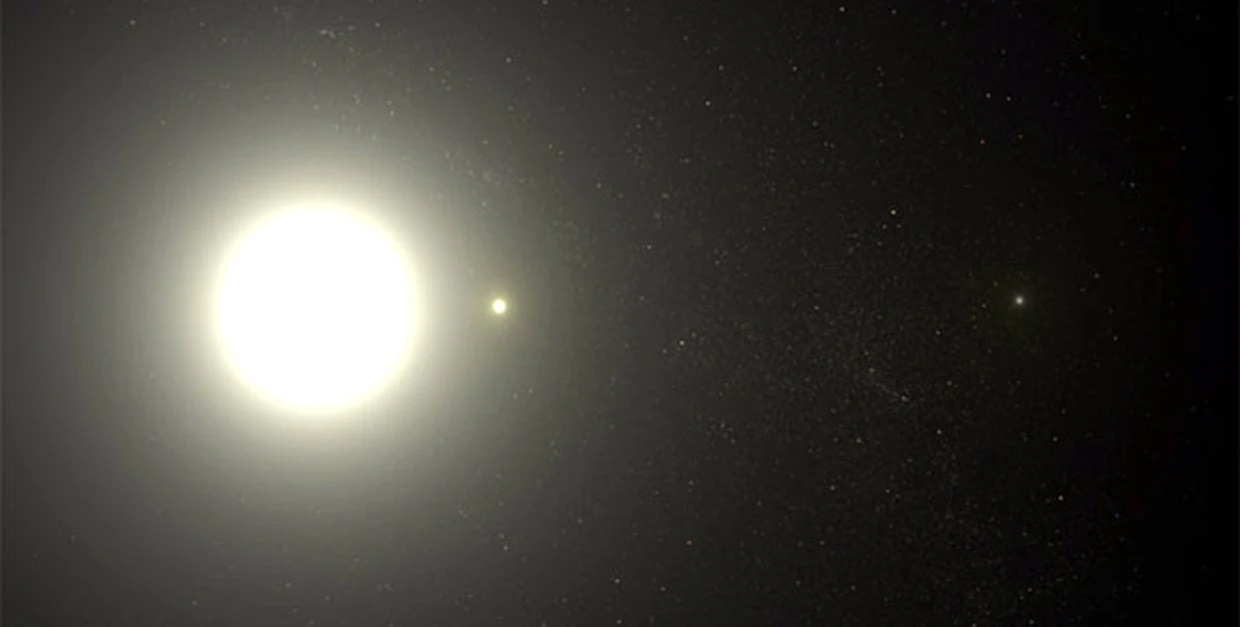
Humanity is fortunate in that there is a star located above the Earth's North Pole. The star, known as Polaris or the North Star, has guided many sailors safely to port. But Polaris is a fascinating star in its own right, and not just because of its coincidental position.
Polaris is also called the Pole Star and is actually a triple star system. The main star is a yellow supergiant called Polaris Aa, about 448 light-years away, and it orbits a smaller companion called Polaris Ab. The outer star is called Polaris B and may also have a dark companion. In this article, Polaris refers to the main star Polaris Aa.
These Hubble images show the positions of the Polaris stars. Polaris Aa is labeled Polaris A in this image, and Polaris AB is labeled Polaris B. Image credit: By NASA/HST – (Image: STScI-2006-02), Public Domain.
Polaris has not always been the North Star and will not always be. Thuban was the North Star from the 4th to the 2nd millennium BC until the precession of the Earth's axis gave Polaris this position. The North Star changes in a cycle of 26,000 years, so Thuban will succeed Polaris in 20346.
But regardless of whether Polaris is the North Star at any given time or not, it is an interesting object whose properties can help us understand the expansion of the universe.
Polaris is a variable star that pulsates and changes its brightness over time. More specifically, it is a Cepheid star. Cepheids expand and contract rhythmically, and their brightness changes in a predictable pattern. Because there is a direct relationship between their pulsation period and their luminosity, they are useful in measuring distances. They are called “standard candles” and are part of the cosmic distance scale.
Astronomers use standard candles to measure the Hubble constant, the rate at which the universe is expanding. However, there is some tension between our measurements of the Hubble constant. When we use local objects such as Cepheids to measure the Hubble constant, we get a different value than when we use larger-scale objects such as the cosmic microwave background to measure it.
Because Polaris is such a close standard candle, a team of astronomers observed the star for 30 years with a telescope array. By observing Polaris and its smaller companion Polaris Ab more closely, they hoped to be able to determine Polaris' mass and other properties more precisely. This, in turn, could help us understand the tension in the Hubble constant. In doing so, the researchers discovered some surprises surrounding this long-observed star.
Their results are summarized in a paper titled “The Orbit and Dynamical Mass of Polaris: Observations with the CHARA Array.” It was published in the Astrophysical Journal and the lead author is Nancy Evans. Evans is an astrophysicist at the Center for Astrophysics | Harvard & Smithsonian.
To better understand Polaris, it is important to take a good look at its faint companion. But that is not easy.
“The close distance and large brightness contrast between the two stars make it extremely difficult to resolve the binary system at their closest approach,” said Evans.
The CHARA (Center for High Angular Resolution Astronomy) array was built to more clearly see objects such as Polaris and its faint companion. It is an interferometer, an array of six separate telescopes, each with a primary mirror one meter in diameter. By combining the images from each telescope, CHARA achieves the higher resolution of a telescope with a primary mirror 330 meters in diameter, the area covered by each telescope. CHARA has a special camera called MIRC-X (Michigan InfraRed Combiner-eXeter) that was designed specifically to work with the array.
Using these tools, the astronomers tracked Polaris and its faint companion over a period of 30 years. They measured how the Cepheid star changed size as it pulsated. They found that it is five times more massive than the Sun and has a diameter 46 times larger than the Sun. However, the mass measurement is affected by the star's large orbital eccentricity of 0.63, so there is still some uncertainty about Polaris' mass.
The measured mass and luminosity also show that Polaris is more luminous than it should be for a star on its evolutionary trajectory. “Polaris is at least 0.4 mag brighter than the predicted orbits,” the authors write in their paper. This is important because of the “Cepheid mass problem,” which is a discrepancy between the masses derived from the stars' evolutionary trajectories and the masses from pulsation calculations.
The mass of a Cepheid can be determined if it is in a binary relationship. “Mass determination starts with a radial velocity (RV) orbit and a pulsation curve for a binary star containing a Cepheid,” the authors explain. Very few Cepheids are in binary relationships like Polaris, so this is an important goal to constrain and understand their masses. These measurements are all important because they relate to the cosmic distance ladder, standard candles, and the Hubble constant.
“The accuracy of the results of these measurements depends on many properties of the star: brightness, orbital period, inclination, as well as the distance, distance and mass ratio of the components. This means that each Cepheid system is unique and must be analyzed independently,” the authors explain.
The observations also showed variable spots on the surface of the star.
“The CHARA images showed large bright and dark patches on the surface of Polaris that have changed over time,” said Gail Schaefer, leader of the CHARA array.
This April 2021 CHARA array false-color image of Polaris shows large bright and dark patches on the surface. Image credit: Evans et al. 2024.
“The identification of starspots is consistent with several properties of Polaris,” the researchers write. It differs from other Cepheids because it has a very low pulsation amplitude. This could mean that its atmosphere is more like that of a non-variable supergiant. These atmospheres often seem to be active, similar to the spots on Polaris. “It is not clear how full-amplitude pulsations affect the atmosphere and magnetic field in pulsators, so Polaris is an interesting test case,” they explain.
The spots are variable, which could explain why astronomers have had difficulty identifying other “extra periodicities” in the star. They could also explain an observed radial velocity variation of about 120 days as the rotation period.
The spots on the surface of Polaris add to the complexity of this star and demand to be understood.
“We plan to continue imaging Polaris in the future,” said study co-author John Monnier, a professor of astronomy at the University of Michigan. “We hope to better understand the mechanism that creates the spots on Polaris' surface.”
Like this:
Load…

Comments are closed.