

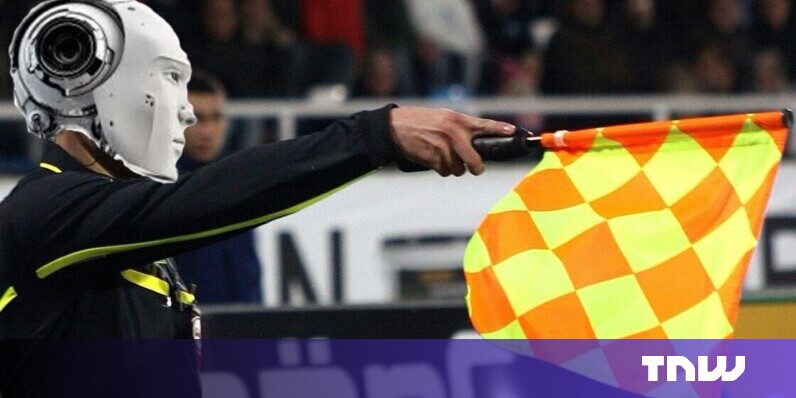
The English Premier League improves the offside decision (semi-)automatically.
The new system revises what is probably the most controversial rule in sport.
The offside rule was first introduced in 1863 and prevents sneaky football players from camping near the goal.
In the current version, the rule only applies to attackers in the opponent's half. Once they enter this space, teammates can only pass to them if they are behind at least two opposing players.
Sounds confusing? Let me explain.
Players can be offside if any part of their body is outside the defense. Or if there is daylight between them. But sometimes only if the attacker is “actively involved in the play.” Got it? OK, me neither.
Officials have tried to refine the rule, but offside decisions still cause anger among footballers and fans.
The latest target of their anger is the Video Assistant Referee (VAR). Designed to verify Decisions A second offside check was carried out on the field. Unfortunately, this also caused new problems.
Not only were the decisions controversial, they were now also painfully slow. The Premier League had to start all over again.
It returned today with a new solution: semi-automatic offside technology (SAOT).
Automated offside positions
SAOT applies optical tracking to soccer players. When a player is offside, the software automatically draws lines in the footage to illustrate his position. Referees then review the footage before making a decision.
By combining automation with human control, the system could improve both accuracy and speed. That's the plan, at least.
Attackers in the blue zone are in an offside position. Source: Genius Sports.
The Premier League will introduce SAOT next season, which begins on Friday. British technology The company Genius Sports was commissioned to develop the system.
The company will install computer vision cameras in every Premier League stadium. According to Genius Sports, the software can create full 3D renderings of the players, ball and offside area in seconds. Referees can then make an accurate decision.
Tony Scholes, the Premier League's head of football, expects the system to improve the flow of the game, claiming SAOT will improve the experience for all participants – “including the fans”.
That's a bold promise that even perfect engineers find hard to fulfill. Because sometimes the only right decision is the one that benefits our team.

Comments are closed.