

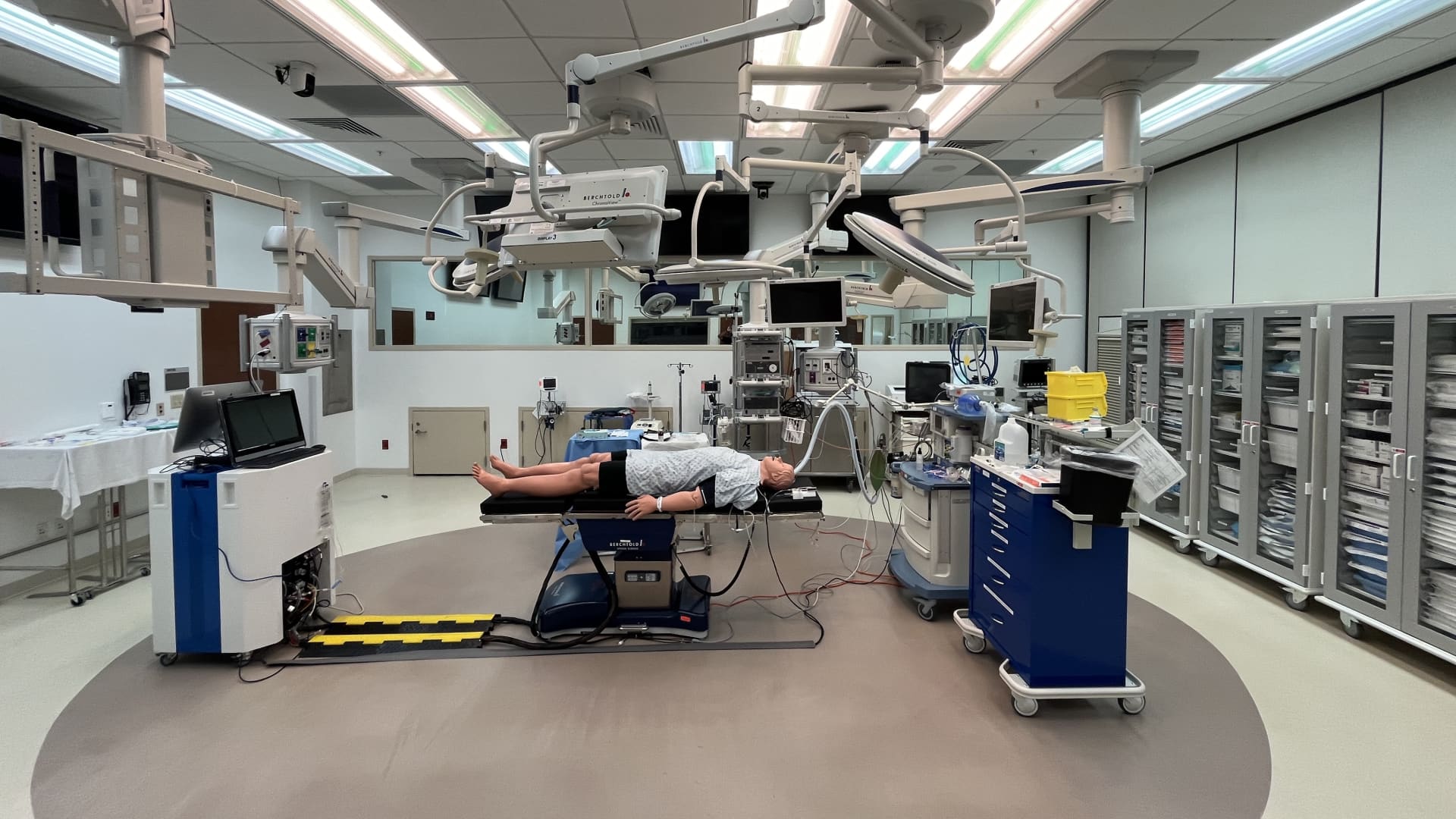
An operating room at SimVET
Courtesy of SimVET
In a massive $43 million Department of Veterans Affairs facility equipped with operating rooms, intensive care units and an outpatient clinic, there are no patients. At least, no real ones.
Located just minutes from Orlando International Airport in Florida, the 55,000-square-foot building is called the National Center for Simulation Validation, Evaluation and Testing, or SimVET. It serves as a central location where teams of VA health care workers come to practice procedures and test new technologies without putting patients at unnecessary risk.
For example, if a team of doctors wants to adjust their response to opioid overdoses or test a new artificial intelligence tool, they can repeatedly simulate the process at SimVET. VA officials told CNBC that by working in a controlled environment, health care workers can iron out kinks and ensure that new ideas are feasible and safe to implement.
SimVET, which opened in 2016, is an example of how simulations in healthcare have become more common and sophisticated in recent years. As healthcare systems look to test hundreds of new AI tools that have recently hit the market, facilities like SimVET can help keep track.
The SimVET facility in Orlando, Florida
Courtesy of SimVET
The Veterans Health Administration cares for 9 million veterans at 172 medical centers across the United States. Each medical center has a simulation program, and some have their own on-site unit.
The SimVET facility in Orlando is “by far” the largest simulation center within the VA and also one of the largest in the country, said Dr. Scott Wiltz, medical director of the VA’s Simulation Learning, Evaluation, Assessment and Research Network (SimLEARN).
Simulating high-risk scenarios is standard practice in the military and in industries such as aviation, where pilots can spend hours practicing in flight simulators.
In healthcare, hospitals and medical schools have long relied on professional actors to train doctors, and virtual reality headsets are becoming increasingly popular for surgical practice. But SimVET takes things a step further.
The goal is usually to be “as close as possible to [to] the highest possible level of realism,” Wiltz said in an interview with CNBC.
“The operating rooms are a great example,” Wiltz said. “We have two fully staffed operating rooms, all the equipment you would normally use: lights, booms, real anesthesia machines. We even have a mannequin that reacts realistically to anesthesia.”
CNBC visited SimVET in March and the dolls are a permanent fixture at the facility. They have a range of skin tones, hairstyles and facial features and some are programmed to talk, move and develop complications. One “older” doll at the facility has wrinkles and more pronounced veins and another can “give birth” to a “baby” doll.
Wiltz said the numbers should represent the VA's veterans and the country's overall population. There are “well over” two dozen mannequins at the facility, he said.
A mannequin in the SimVET facility
Courtesy of SimVET
Aside from its unusual patients, SimVET features many familiar-looking healthcare scenes. Neon lights line a long hallway filled with exam rooms, and operating rooms filled with machines look like they've been taken straight out of a nearby hospital.
To an unsuspecting visitor, the facility looks like a real medical center, with the building's many classrooms and teaching rooms being the only small hint of this.
“The variety of spaces we have and the realism that comes with it really makes you feel like you could actually care for patients in this building,” Wiltz said. “And that's what we do, except our patients are puppets and actors.”
A place where you can surely fail
The SimVET building in Orlando, Florida
Courtesy of SimVET
Wiltz said SimVET employs about 60 full-time staff and typically tackles several pilots and projects at once. National program offices and front-line staff at the VA come to SimVET with ideas for simulations, and sometimes facility staff come up with the idea themselves, he said.
SimVET can offer its services with funding directly through the VA, and so Wiltz says it often makes more sense for these groups to turn to SimVET rather than trying to pay someone outside of the government.
Amanda Borchers, patient safety manager at the Lexington VA Medical Center in Kentucky, was part of a surgical emergency team that visited SimVET in May of last year. She said they wanted to improve their response to unexpected complications that can arise during surgery, so they approached SimVET with ideas in the winter of 2023.
Borchers said some of the more vulnerable veterans in her group have respiratory, cardiac and circulatory problems that can cause sudden problems during procedures. Her team wanted to develop a new protocol to be better prepared for some of those challenges, such as how to quickly draw blood and get it to an operating room.
SimVET leadership helped Borchers and her four other teammates write several simulations before arriving on site and put them in touch with a number of subject matter experts from across the country.
The team spent a busy week at SimVET's facility: their first day started promptly at 7am at a drawing board, and then they spent hours going through various procedures and discussing issues with the experts and SimVET staff.
“You can fail, but you fail safely, and then you use that to change something. And then you do it again. And then you do it again,” Borchers said in an interview with CNBC. “The transformation and what we were able to do in an unforeseen emergency was amazing.”
Borchers said she has participated in simulations before, but has never experienced anything quite like SimVET. She said the facility replicates the environment she works in every day, allowing her to practice “every single detail” of her routine work.
“It's exactly the same,” she said. “You could actually do an operation there right now.”
A room in the intensive care unit of SimVET
Courtesy of SimVET
At the end of the week, Borchers and her team left SimVET with the framework for a brand-new medical code, which represents a facility-wide response to a specific type of emergency. For example, TV shows and movies often talk about “Code Blue,” in which medical personnel immediately intervene when a patient goes into cardiac or respiratory arrest.
Borchers said the new code the team developed will be announced over the loudspeakers as “Code SET,” which stands for “Surgical Emergency Team.” She said it is intended to alert a special team to provide support if unexpected complications arise during or immediately after surgery.
SimVET gave Borchers and her teammates their first practice and the confidence they needed in their idea, but they still needed to get the rest of the Lexington VA Medical Center on board. They introduced the code to their leadership and began to determine exactly which people and resources would respond to it.
Borchers said the medical center has begun running its own simulations and developing code within small parts of the hospital in the fall. In the spring, they expanded their testing and began running facility-wide simulations with the code.
The medical center is currently upgrading its paging system, and Borchers said the facility will simulate the code again once the new system is installed. If all goes according to plan, the SET code will be in use with real patients in the next two to three months.
Borchers said their ultimate goal is to deploy the SET code in VA medical centers across the country, and staff from states such as Tennessee, Mississippi, Louisiana, Arkansas and Texas have already participated in simulated training.
Wiltz said the code is on track to become a national program at the VA.
“Fortunately, this is not due to an adverse event, but rather to people saying, 'You know what, we're doing things pretty well, but we think we can do even better,'” Wiltz said.

Comments are closed.