

Essay by Eric Worrall
So much for the great secret conspiracy of the oil companies. In 1977, Marathon Oil published an article in a company magazine saying that CO2 could lead to mass starvation.
A US oil company published an article in 1977 predicting that the climate crisis could trigger famines
Marathon Petroleum’s predecessor warned of possible “social and economic disasters” in a decades-old publication
Geoff Dembicki Thu 18 Jul 2024 22.00 AESTShare
The predecessor of Marathon Petroleum, America’s largest oil refinery, declared in an economic journal nearly 50 years ago that global temperature rise, possibly linked to “industrial expansion,” could one day cause “widespread hunger and other social and economic disasters.”
This decades-old description of climate change comes from a 1977 issue of Marathon World magazine and is attributed in the article by an unnamed author to several experts, including a scientist who works for a leading U.S. agency.
“Although climate scientists do not agree on the underlying reasons, many predict a future climate with greater variability that will bring areas of extreme drought,“, said the magazine, which was formerly published by Marathon Oil Company, which later split into Marathon Petroleum and the exploration and production company Marathon Oil.
Marathon Petroleum is one of several oil and gas companies – including Exxon, Shell and BP – currently being sued by the City of Honolulu for allegedly conducting a coordinated communications effort to conceal and deny “their own knowledge” of the catastrophic climate impacts caused by burning their products.
…
Read more: https://www.theguardian.com/us-news/article/2024/jul/18/us-oil-marathon-petroleum-climate-change
A company magazine is not necessarily a secret internal memo.
The claim that the oil companies knew in the 1970s that we were heading for certain doom and tried to cover up that knowledge is absurd even without this recent revelation. Because even climate scientists had completely different opinions in the 1970s.
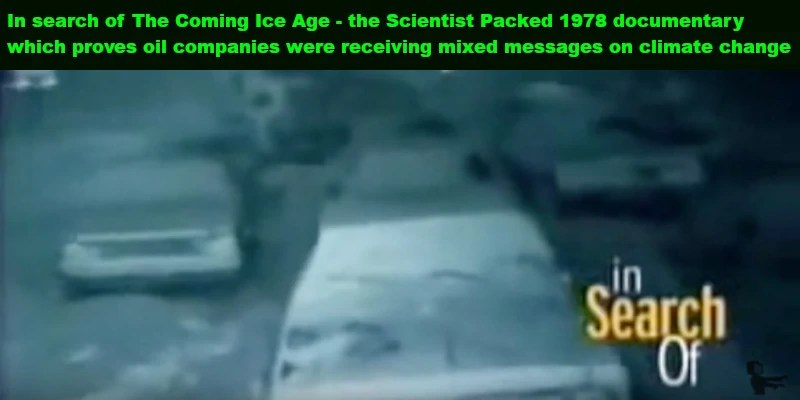
Renowned scientists such as Gifford Miller, Stephen Schneider, Chester Langway and James Hayes appeared in the hugely popular 1978 documentary In Search of… the Coming Ice Age. The scientists in the documentary defended their claim that the world was on the brink of a global cooling catastrophe. Schneider proposed using nuclear reactors to melt the polar ice caps.
I remember watching this documentary as a child. The host was Leonard Nimoy, the original Star Trek Doctor Spock. All the adults were worried about this icy threat to their children's future.
The lack of certainty about the science is compounded by the “secret” internal memos that are said to be the smoking guns of the Big Oil companies' fabricated conspiracy theory. For example, the following is a copy of the 1982 Glaser memo distributed to Exxon management.
The memo – and remember that it was a private internal memo – is far from certain that climate change will have catastrophic effects. For example, at the bottom of page 4, further up on page 5.
“Currently there are no clear evidence that the earth is warming. If the Earth is on a warming trend, we are unlikely to detect it before 1995. This is about the earliest forecast for when temperatures could rise by the 0.5° needed to exceed the range of normal temperature variation. On the other hand, if climate model uncertainties have exaggerated temperature increases, it is possible that a carbon dioxide-induced 'greenhouse effect' may not be detected until 2020 at the earliest.”
Why did the oil companies not adjust their position when climate activists began to dominate the scientific debate?and scientists like Stephen Schneider have abandoned the sinking ship and joined the camp of global warming proponents?
There is a lot of evidence that CO2 is not the cause of climate change – in the paleo record, CO2 follows climate change, not the other way around. The climate change that caused historical changes in CO2 levels was caused by something else – including downward temperature swings when CO2 levels were high.
But there is a more obvious explanation for why executives at oil companies and other companies do not take every turn of the scientific doomsday movement seriously: Alarmists are consistently wrong in their predictions.
Hardly a day goes by without us realizing once again that the catastrophic predictions of “scientific consensus” have turned out to be completely wrong.
What happened to the 1.5 degree Celsius safety limit for global warming?
The prediction errors and alarmism of the scientific disaster movement were just as obvious in the 1970s as they are today. In his best-selling book “The Population Bomb”, published in 1968, Paul Ehrlich predicted mass famine within a decade.
The battle to feed the whole of humanity is over. Hundreds of millions of people will starve to death in the 1970s, no matter what emergency programs we initiate now. At this late stage, nothing can prevent a significant increase in the global death rate.
Many of the oil company executives who ignored the global warming alarmism in the 1970s and 1980s were well aware of the mispredictions in Ehrlich's book.and they would also have heard of scientists like Stephen Schneider, who went from calling for fossil fuels to be shut down to prevent the next ice age to calling for fossil fuels to be shut down to prevent the world from overheating in just a few years. They would all have seen Schneider preaching global cooling in the documentary “In search of,” and their own researchers would have told them how Schneider vacillated between fear of global warming and fear of global cooling in the 1970s.
Wikipedia states that Schneider's discovery of global warming occurred in 1974. But if this is the case, why did Schneider appear in the 1978 documentary In Search of and suggest that the polar ice caps were melting? Was it a case of “What does Schneider say this week?”? No wonder the oil company executives did not take the matter seriously.
Given decades of unclear scientific findings and changing doomsday prophecies, there is one thing we know for sure.
In the year the oil companies close, six billion people die of hunger.
Fossil fuels are absolutely essential for producing the fertilizers and pesticides, and for transporting the food that has allowed the world's population to grow from millions to billions. Even nuclear power could not replace all of the fossil fuels that make modern society possible without trillions of dollars in additional investment. If fossil fuels were to be mined today, or even in the next decade, food production methods would have to return to 18th century agricultural practices, and most people alive today would certainly die.
Like this:
Is loading…
Related
Discover more from Watts Up With That?
Subscribe to receive the latest posts via email.

Comments are closed.