

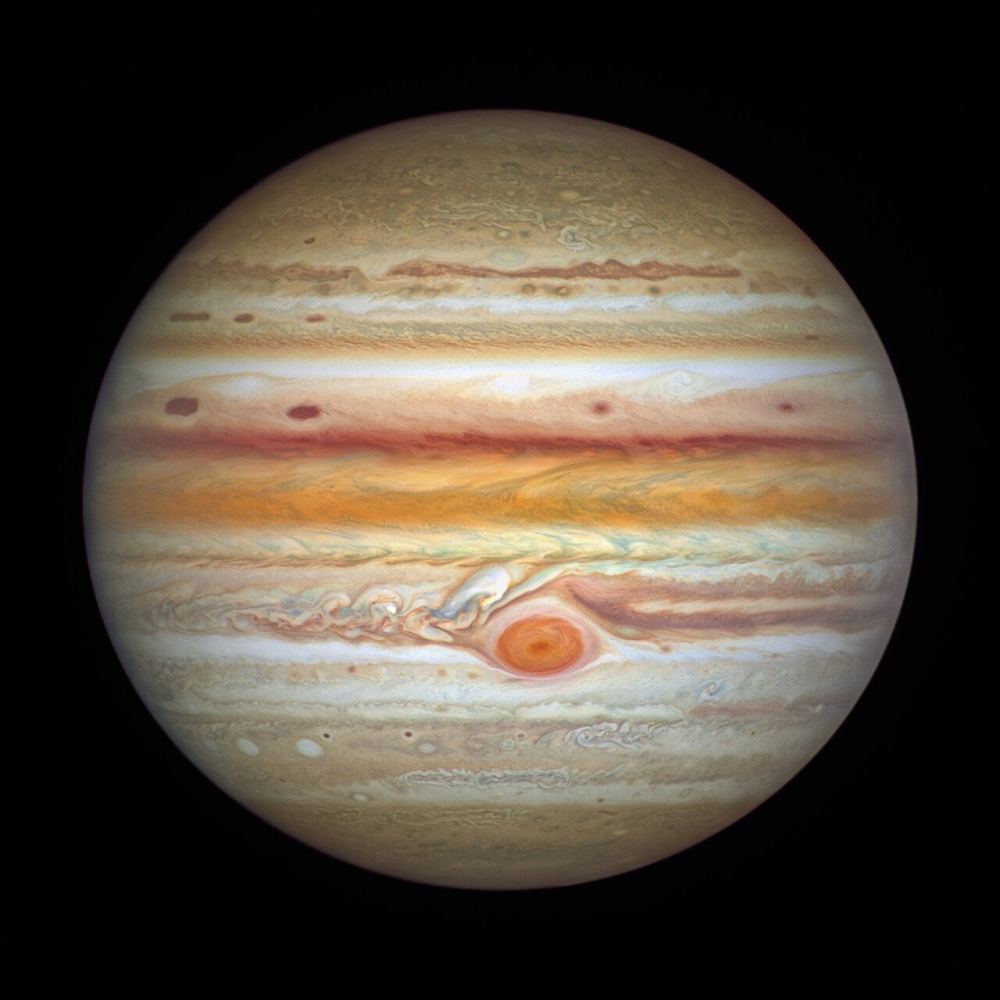
The largest storm in the solar system is shrinking, and planetary scientists think they have an explanation. It may be related to a reduction in the number of smaller storms feeding it, potentially starving Jupiter's centuries-old Great Red Spot (GRS).
This storm has fascinated observers of its location in Jupiter's southern hemisphere since it was first spotted in the mid-17th century. Continuous observations began in the late 19th century, allowing scientists to record a constant parade of changes. In the process, they have learned a lot about this place. It is a high-pressure region that produces a 10,000-mile-wide anticyclonic storm with winds in excess of 200 mph. The storm extends through the atmosphere to a depth of about 155 miles beneath cloud tops composed primarily of ammonia.
A zoomed-in view of the Great Red Spot based on Juno observations. Courtesy of Kevin Gill.
Modelling a shrinking and growing Great Red Spot
Last century, scientists noticed that the Great Red Spot was shrinking, which left them puzzled. Caleb Keaveney, a doctoral student at Yale University, had the idea that perhaps smaller storms feeding the Great Red Spot could play a role in starving it. He and a team of researchers focused on their influence and ran a series of 3D simulations of the spot. They used a model called the Explicit Planetary Isentropic-Coordinate (EPIC) model, which is used to study planetary atmospheres. The result was a series of computer models that simulated interactions between the Great Red Spot and smaller storms of varying frequency and intensity.
A separate control group of simulations left out the small storms. Then the team compared the simulations. They saw that the smaller storms seemed to strengthen and grow the Great Red Spot. “We found through numerical simulations that we can modulate its size by feeding the Great Red Spot with smaller storms like those found on Jupiter,” Keaveney said.
If that's true, then the presence (or absence) of these smaller storms could change the size of the spot. Essentially, many smaller spots cause it to grow larger. Fewer small spots cause it to shrink. Moreover, the team's modeling supports an interesting idea. Without forced interactions with these smaller vortices, the spot can shrink over a period of about 2.6 Earth years.
Use earth storms as a comparison
The Great Red Spot is not the only place in the solar system that has such a long-lived high-pressure system. There are many of them on Earth, usually called “heat domes” or “heat blocks.” Most of us are familiar with heat domes because we experience them during the summer months. They often occur in the upper atmosphere jet stream that circulates across our planet's mid-latitudes. We can blame them for some of the weather extremes that humans experience – like heat waves and extended droughts. They tend to last a long time and are associated with interactions with smaller, transient weather events like high-pressure vortices and anticyclones.
Because the Great Red Spot is an anticyclonic phenomenon, Keaveney said it has interesting implications for similar atmospheric structures on both planets. “Interactions with nearby weather systems have been shown to maintain and enhance heat domes, which supported our hypothesis that similar interactions on Jupiter could maintain the Great Red Spot,” he said. “By confirming this hypothesis, we provide additional support for our understanding of heat domes on Earth.”
The ever-changing Great Red Spot
In addition to the Great Red Spot changing in size, observers are also noticing changes in its color. It is primarily reddish-orange, but has been known to fade to a pinkish-orange hue. The colors indicate that complex chemical processes triggered by solar radiation are taking place in the region. They affect a chemical compound called ammonium hydrosulfide as well as the organic compound acetylene. This creates a substance called tholin, which imparts a reddish color wherever it is found.
Sometimes the spot has almost completely disappeared due to a complex interaction with a structure called the Southern Equatorial Belt (SEB). The SEB is where the spot is located, and when it is bright and white, the spot becomes dark. At other times, the opposite color change occurs. In some cases, the SEB itself has disappeared at various times. No one is quite sure why this happens, but it is another piece of Jupiter's atmospheric puzzle.
These Hubble images of Jupiter, taken 11 months apart, show that the southern equatorial belt has disappeared. Note the presence of the Great Red Spot. Image credit: NASA, ESA, MH Wong (University of California, Berkeley, USA), HB Hammel (Space Science Institute, Boulder, Colorado, USA), AA Simon-Miller (Goddard Space Flight Center, Greenbelt, Maryland, USA), and the Jupiter Impact Science Team.
Changes in the Great Red Spot have been studied in detail not only from the ground but also by spacecraft, from Voyager to Galileo to Cassini and Juno. Each spacecraft used special instruments to study the spot, measuring its wind speeds and temperatures and sampling gases and compounds in the upper atmosphere. All of this data feeds models like the one used at Yale to model the contribution of smaller storms to the growth and shrinkage of the Great Red Spot.
For more informations
A new explanation for Jupiter’s large, shrinking “spot”
Influence of transient vortex interactions on the size and strength of Jupiter's Great Red Spot
Juno and the Great Red Spot
Like this:
Is loading…

Comments are closed.