
Largest Research of Asia’s Rivers Reveals 800 Years of Paleoclimate Patterns – Watts Up With That?

The SUTD study will be crucial in assessing future climate changes and making more informed decisions about water management.
SINGAPORE UNIVERSITY OF TECHNOLOGY AND DESIGN
Research news
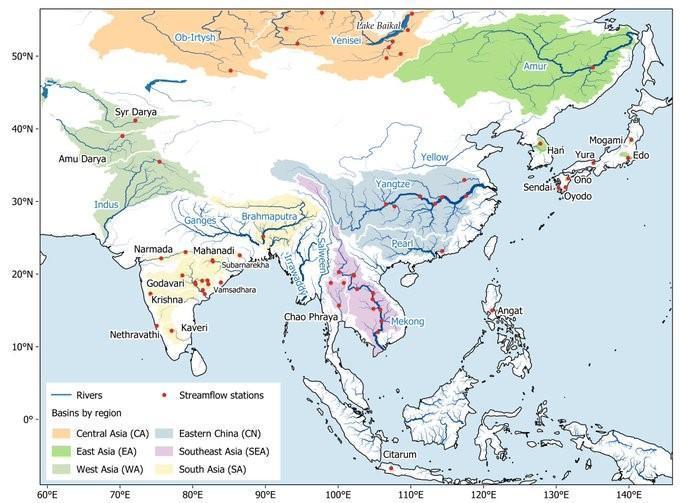
PICTURE: MAP OF THE ASIAN MONSOON REGION; RIVER BASINS INVOLVED IN THIS STUDY ARE HIGHLIGHTED BY THE SUBREGION, RIVERS THAT ARE THE 30 LARGEST IN THE WORLD ARE DISPLAYED WITH BLUE NAMES. Show more CREDIT: SUTD
813 years of annual river discharge at 62 stations, 41 rivers in 16 countries, from 1200 to 2012. This is what researchers at the Singapore University of Technology and Design (SUTD) produced after two years of research in order to better understand earlier climate patterns in the Asian monsoon region.
The Asian monsoon region is home to many populous river basins, including ten of the largest rivers in the world (Figure 1). It supplies more than three billion people with water, energy and food. Therefore, it is crucial for us to understand past climate patterns so that we can better predict long-term changes in the water cycle and their effects on the water supply.
To reconstruct the history of the river discharge, the researchers relied on tree rings. A previous study by Cook et al. (2010) developed an extensive network of tree ring data locations in Asia and created a paleodrought dataset called Monsoon Asia Drought Atlas (MADA). SUTD researchers used the MADA as an input for their flow discharge model.
They developed an innovative process to select the most relevant subset of the MADA for each river based on hydroclimatic similarity. With this method, the model was able to extract the most important climate signals that influence river discharge from the underlying tree ring data.
“Our results show that rivers in Asia behave in a coherent pattern. In neighboring or nearby basins, large periods of drought and large pluvial periods have often occurred simultaneously. Sometimes droughts stretched from Godavari in India to the Mekong in Southeast Asia (Figure 2). This has important implications for water management, especially when a country’s economy depends on multiple river basins, as in the case of Thailand, ”said first author Nguyen Tan Thai Hung, a PhD student at SUTD.
With modern measurements it is known that the behavior of Asian rivers is influenced by the oceans. For example, if the Pacific gets warmer in its tropical region during an El Nino event, it alters atmospheric circulations and is likely to cause droughts in South and Southeast Asian rivers. However, the SUTD study found that this ocean-river connection is not constant over time. The researchers found that rivers in Asia were much less affected by the oceans in the first half of the 20th century than in the 50 years before and 50 years after that time.
“This research is of great importance to policy makers. We need to know where and why river runoff has changed over the past millennium in order to make important decisions about water-dependent infrastructure. An example of this is the development of the ASEAN power grid, which is intended to connect a system of hydropower, thermoelectric and renewable energy supply systems in all ASEAN countries. Our records show that “mega-droughts” hit multiple power generation sites at the same time. Hence, we can now use this information to design a network that is less vulnerable to extreme events, ”said SUTD’s lead investigator Associate Professor Stefano Galelli.
###
Like this:
Loading…

Comments are closed.