

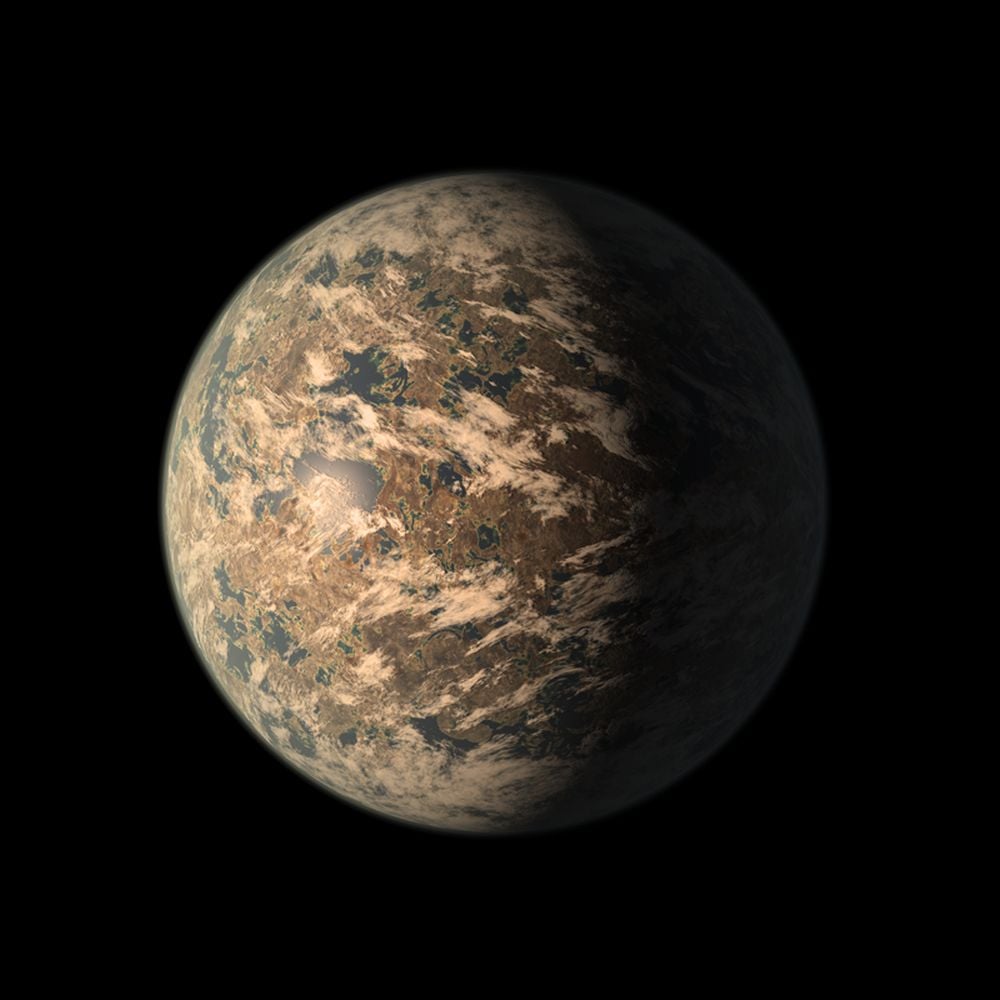
The hunt for terrestrial exoplanets in habitable zones is on, and some of the most promising candidates were discovered about 40 light-years from Earth nearly a decade ago. The TRAPPIST-1 system contains seven Earth-like planets, four of which may be in the habitable zone. The star is a faint red dwarf, so the habitable zone is close to the star, as are the planets. For this reason, astronomers believe they are tidally locked to the star.
The JWST was created to address four major topics of science, including planetary systems and the origins of life. It can study the atmospheres of exoplanets using infrared transit spectroscopy, in which light from a star penetrates an exoplanet’s atmosphere as it passes in front of the star. With this method, the JWST can detect molecules in the atmosphere.
The space telescope has done this for several targets, including planets in the TRAPPIST-1 system. But it faces a serious problem: stellar contamination.
New research to be published in the Astronomical Journal outlines JWST observations of TRAPPIST-1 e, a planet about the same size as Earth that has emerged as a major target in exoplanet science. The focus is on a method for removing stellar contamination in JWST observations of exoplanet atmospheres. The study is titled “JWST TRAPPIST-1 e/b Program: Motivation and First Observations” and is currently available on arxiv.org. The lead author is Natalie Allen, a doctoral candidate in the Department of Physics and Astronomy at Johns Hopkins University.
“One of the foremost goals in the field of exoplanets is the discovery of an atmosphere on a temperate terrestrial exoplanet, and one of the most suitable systems for this is TRAPPIST-1,” the authors write in their research. “However, JWST transit observations of the TRAPPIST-1 planets show significant contamination by stellar surface features that we cannot reliably model.”
To know that the JWST is measuring an exoplanet’s atmosphere, astronomers need to be able to remove starlight from the signal. But stars are not uniform, and that is difficult. They have cooler regions called starspots and hotter regions called faculae. When a planet passes in front of a star, it blocks part of the star, but not all of it. When the planet blocks a star or sunspot, it can produce false signals that simulate the presence of certain molecules in the planet’s atmosphere. In addition, the peripheral regions of a star have different temperatures and spectral properties than its center.
This stellar contamination makes the whole endeavor a complicated puzzle, and for a powerful telescope like JWST it’s even worse because subtle signals can be amplified. “However, observations during transmission were more difficult to interpret,” the authors write. “M dwarfs are known to be generally magnetically active, with abundant evidence of rotational modulation due to active stellar surface regions rotating in and out of the field of view.” In addition, red dwarfs like TRAPPIST-1 are known to have very active surfaces with strong flare, which further exacerbates the problem.
The JWST has already performed atmospheric spectrometry on exoplanets and has had to deal with stellar contamination. In 2023, astronomers used it to study the atmosphere of the rocky exoplanet GJ 486 b, a super-Earth orbiting a red dwarf about 26 light-years away. They detected water vapor, an important discovery, but were unsure whether the water vapor signal came from the planet’s atmosphere or from the star itself.
This image shows the transmission spectrum of the exoplanet GJ 486 b. The JWST detected water vapor, but astronomers could not be sure that the water vapor signal came from the exoplanet’s atmosphere or from star spots on the red dwarf star it orbits. The blue line represents atmospheric signals and the orange line represents starspots. Image source: Illustration: NASA, ESA, CSA, Joseph Olmsted (STScI); Science: Sarah Moran (University of Arizona), Kevin Stevenson (APL), Ryan MacDonald (University of Michigan), Jacob Lustig-Yaeger (APL)
Astronomers have already used the JWST to examine another of the TRAPPIST-1 planets – Planet B. In fact, JWST observed the TRAPPIST-1 system for more than 400 hours, clearly indicating the system’s scientific importance. Planet b is airless, so its signals can be used as a basis for modeling stellar contamination, hopefully removing it from JWST observations of planet e.
“Here we present the motivation and initial observations of our JWST multi-cycle program of TRAPPIST-1 e, which uses close transits of the airless TRAPPIST-1 b to correct for stellar contamination in a model-independent manner, with the aim of determining whether TRAPPIST-1 e has an Earth-like medium molecular weight atmosphere containing CO2,” the authors explain.
This figure from the research shows some of the results and some of the obstacles that stellar contamination poses. Each panel represents one of the JWST transit observations, with the panel below showing H-Alpha. Peaks in H-alpha represent a stellar outburst, and a stellar outburst occurred immediately before the emergence of Planet E. Image credit: Allen et al. 2025.
The article presents only the first observations of TRAPPIST-1 e in a multi-cycle program. Previous observations of the exoplanet with the JWST showed extreme stellar contamination. The question they are trying to answer is whether their modeling of the airless TRAPPIST-1 b can help them filter out stellar contamination on TRAPPIST-e. Their results suggest that this should be possible with some limitations.
These initial observations highlight the problem of stellar contamination.
“The most obvious and problematic additional complication to our observations is the presence of flares of varying strength and frequency visible in each observation in Hα,” they write. Starspots and active regions stand out clearly in H-alpha observations. All of these activities and observations in H-Alpha contradict the idea that TRAPPIST-1 b can be used to understand the atmosphere at TRAPPIST-1 e. “These bursts refute the inherent assumption of our near-transit technique that the stellar surface remains the same between transits of planets e and b,” the authors explain.
But their proposed monitoring program should be able to get around this. They suggest observing only 15 close transits. Close transits occur when there are less than eight hours between the transit of TRAPPIST-1 b and TRAPPIST-1 e. That’s about 10% of the star’s 3.3-day rotation period. “This is a fraction of the rotation period that is small enough that there should be no significant rotation of the stellar surface between observations, but yet flexible enough that we can find sufficiently close transit instances in the near future,” the researchers explain.
The early results of this study suggest that their mass transit method will work.
“We show that through our proposed and accepted 15 close transit observations we would be able to detect an Earth-like atmosphere with strong predictive power,” the authors explain. But it depends on a specific molecular signal. “Our ability to detect an atmosphere depends heavily on the presence of the 4.3 µm CO2 feature, which is predicted to be a common result of secondary atmosphere formation,” they write. Secondary atmospheres differ from a planet’s primary atmosphere because they can reflect biological activity.
The CO2 feature at 4.3 µm is important because it is one of the strongest absorption bands of the molecule. Because it is relatively isolated from other signals in a spectrum, it is less likely to be confused with stellar contamination.
This study presents a possible solution to the problem of stellar contamination. This problem is not limited to TRAPPIST-1 or just red dwarfs. All stars have surface activity that must be taken into account when characterizing the atmosphere.
“The problem of stellar contamination extends well beyond the TRAPPIST-1 system and has been a significantly complicating factor in the search for an atmosphere on a rocky exoplanet, for which we currently have no conclusive evidence,” the authors conclude.

Comments are closed.